
Welcome to the Autospeed Blog. Use of this site must adhere to our terms and conditions.

DIY Electric Cars!

Posted on November 7th, 2007 in Driving Emotion,Economy,Hybrid Power,Opinion,Technologies by Julian Edgar

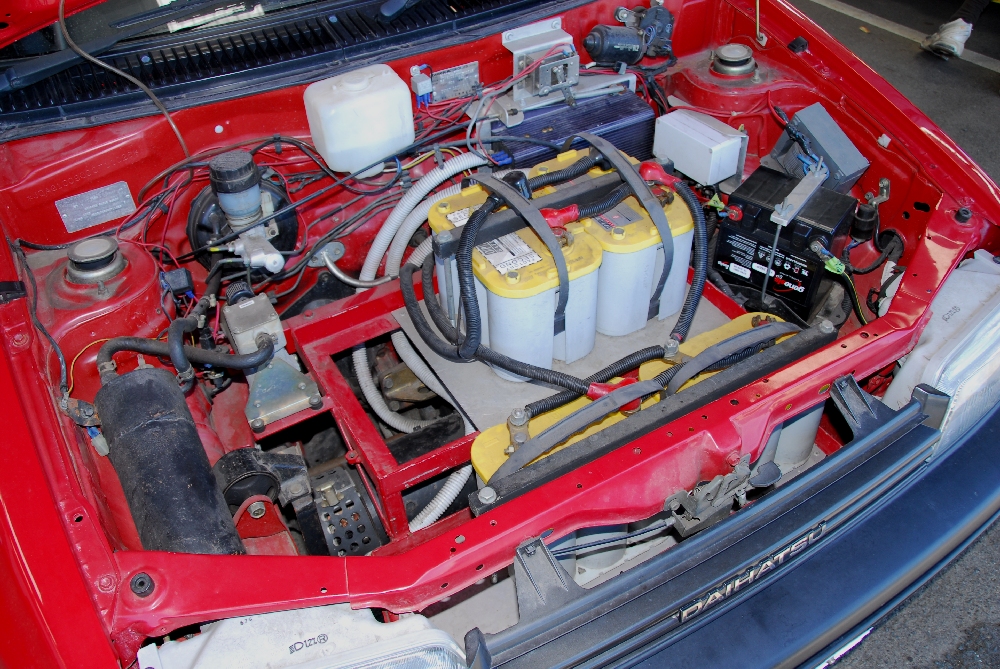
electric-charade.jpgLast weekend I attended an electric car show. Organised by the Sydney branch of the Australian Electric Vehicle Association, it was unlike any other car show I’ve ever been to.

Why?

Well, firstly, the cars were different to 99 per cent of vehicles on the road. With the exception of a few current model Prius Toyotas, they were all home-converted battery electric vehicles. That’s right, (mostly) road-registered and street driven, these cars never visited petrol stations but instead needed only to be plugged into mains power.

Another thing rather different about the show was the interest being shown by visitors.

At a typical car sow you’ll get lots of lookers but few talkers. Here, every visitor had dozens of questions – and some even came equipped with notebooks and were writing down the answers. One guy had come all the way from Canberra and was actively seeking the information to enable him to have a car converted to electric power for his daily commute.

Others were asking about conversion costs, battery life, range, performance – and everything else you could imagine.

There was a constant buzz of interested conversation.

Along with the road-registered cars, there was also an electric kart, a half-built electric clubman and an electric motorbike. The road vehicles included a Camry wagon, Daihatsu Charade, Hyundai Excel, Daewoo Lanos and even a Mazda ute.

I was attending the show to gather material for some AutoSpeed stories, and got to drive three of the cars. We’ll be running these stories in due course, but in the mean time, if you’re at all interested in building your own battery electric car – or having a car converted to battery electric power – be aware that there’s a bunch of very enthusiastic and helpful people available to you as a resource.

No electronics…

Posted on November 5th, 2007 in Opinion,Peugeot by Julian Edgar

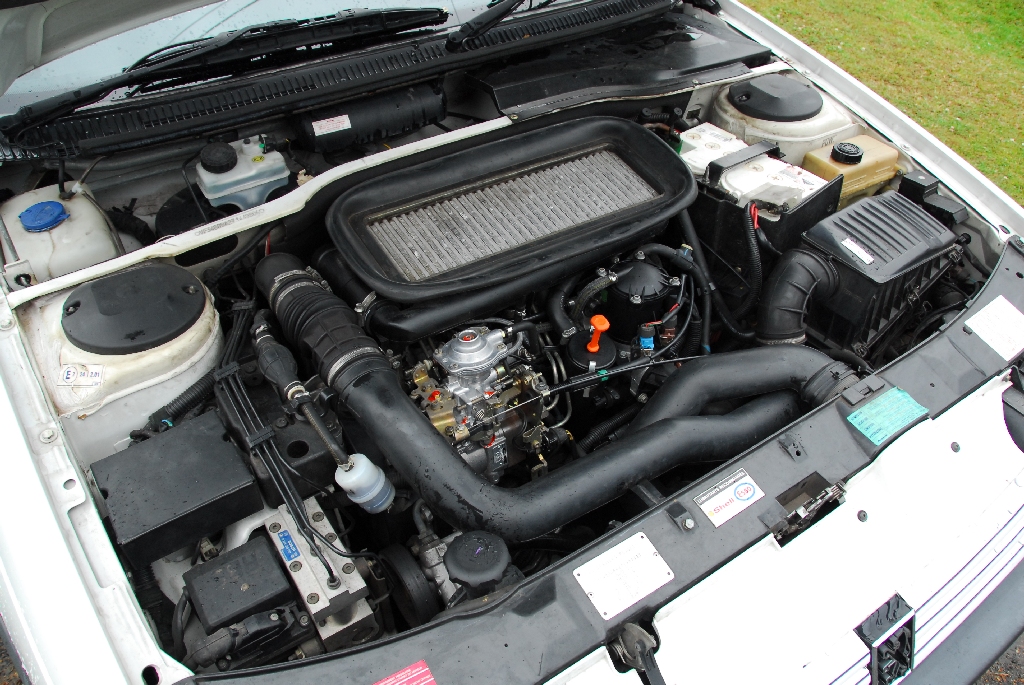
pug-engine.jpgPerhaps I am unusual in that as a guy in his mid-forties, I’ve owned relatively few carburetted cars. My first two cars were carby, but after that my main cars have always had electronic injection. And so I’ve got completely used to thinking in terms of cars with plenty of electronics controlling the fuel and ignition.

So it’s a real shock when I start thinking through modifications for my newly-acquired Peugeot 405 SRDT diesel. Clearly, being a diesel, you don’t expect to see spark plugs and an ignition coil and coil module and stuff like that. But the absence of a crank-angle sensor, MAP sensor or airflow meter, intake air temperature sensor and ECU comes as a bit of a shock. (The Pug injection is the old mechanical Bosch system, rather than today’s electronically controlled common rail system, that in many ways resembles a conventional petrol injection system.)

The shock isn’t so much in making changes to the fuel system; it’s in all the other avenues which are no longer viable. For example, the Independent Electronic Boost Control kit worked extremely well when I developed it. But I can’t use it on the Pug because there’s no electronically varying injector pulse width!  The Intelligent Turbo Timer  is another project that immediately springs to mind – but again I can’t use it because there’s no electronic indication of load.

And I’m finding that I really need to change completely how I think. A week or so after buying the car I was finding it harder and harder to get it started. The engine would crank many times before it sprang into action – to then, paradoxically, idle and run perfectly. What could be the problem? The cranking speed sounded a bit low so I put a multimeter across the battery – it showed just 7 volts on cranking! Hmm, I immediately thought, I bet the ECU can’t compensate in its injector pulse width when the voltage is so low – and the spark’ll be weak too! Except, there’s no spark and no ECU! Instead, the low cranking speed results in less compression pressure, and so temp build-up, and so ignited fuel. (I put in a new battery and the problem was immediately solved.)

None of these ideas is earth-shattering. But it’s interesting how I need to so dramatically change my mind-set – I guess, just the same as if I went back to modifying a carby car….
Black dye…

Posted on November 2nd, 2007 in Driving Emotion,Opinion,Reviews by Julian Edgar

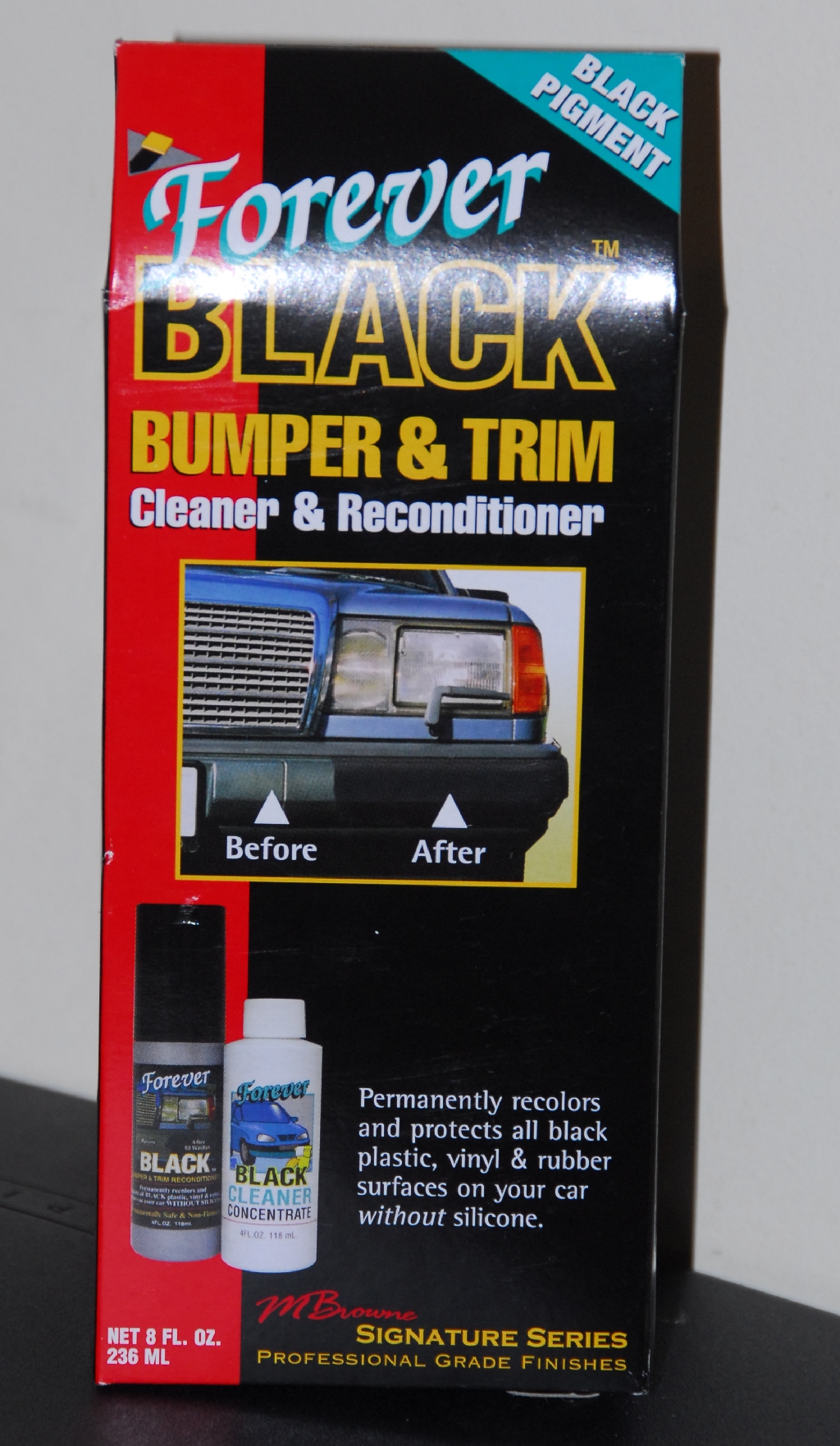
forever-black.jpgIf you own – or buy – an Eighties or Nineties car you’ll invariably find it has lots of black plastic exterior bits. Bumpers are the biggest examples but often there’ll also be side protector strips and rear vision mirrors.

And nothing looks worse on these cars than when the rich, deep black turns to a friable grey.

My Peugeot 405 SRDT is one of the breed with lots of exterior black plastic trim. And, especially against the white paint, the black-that-was-now-grey looked terrible. I tried some exterior trim restorer – a good brand of stuff, quite expensive – and it didn’t fix the problem. (But on another car, with rubber strips rather than plastic, it worked well.) So I went back to the auto parts shop and looked again.

What I came home with is pictured above – Forever Black Bumper and Trim Reconditioner. The on-box blurb says: “Permanently recolors and protects all black plastic, vinyl and rubber surfaces on your car without silicone”.

And now, having applied the stuff, that description seems pretty well on the money. Because you see, this liquid is basically a dye! You clean the surface with the provided cleaner (I must say that, having just cleaned the car, I didn’t bother using the cleaner) and then apply the liquid via a foam applicator, a bit like shoe polish. The instructions suggest masking off surfaces you also don’t want black, and I did a combination of this and later using polish to remove the excess that had got past the masking and onto the paint.

Grey, faded surfaces turn to a rich black – and if they don’t, you simply put on a second coat. It’s nothing like the other ‘black surface’ restorers I have used – although over the years I’ve tried only a handful so am certainly no expert.

The rear bumper of the Peugeot clearly needed less, so perhaps it had been replaced during the life of the car. The front bumper needed two coats.

The end result makes the car look vastly better, not just in that it looks less tired, but also in that the original designers’ intentions are now much clearer – the body visually ties together better.

I saw a Euro Barina on the road the other day – perhaps along with the Ford Ka the car most in need of black plastic restorer. But what made me notice the Barina was how good it looked – someone had spent some time with some black dye…

Groundbreaking fuel consumption?

Posted on October 30th, 2007 in Driving Emotion,Economy by Julian Edgar

A class in the recently completed Darwin – Adelaide World Solar Challenge was designed to showcase commercially available vehicles. The Greenfleet Technology Class had seven vehicles: Audi A3 Sportback diesel, Hyundai i30 diesel, Toyota Prius Hybrid, two Peugeot 207 diesels, Puegeot 307 diesel and a Smart ForTwo petrol.

The fuel economy figures for the event are now in, and the Hyundai i30 convincingly won with an average of just 3.2 litres/100km. That’s stunningly good – better than the Smart (4.6 litres/100km) and the Prius (5.6 litres/100km). Second place went to the Audi A3 with 3.3 litres/100km, with the Peugeot 207 (both cars) at 3.9 litres/100 and the 307 at 5.1 litres/100.

But the figures don’t tell the whole story. The Audi and Hyundai were, in the organiser’s words, “driven conservatively by motoring professional[s]” while the other cars were driven in “everyday driving style”.

We’re not told average speeds and even, for example, if the air conditioning was used.

It’s absolutely fair enough that in an event of this type, drivers try to get the utmost economy out of their cars. It’s a competition, and the winners are those with the lowest fuel consumption and greenhouse gas emissions.

But that’s all it is – a fuel consumption competition, held at almost constant throttle on nearly flat roads for thousands of kilometres.

I am all for fuel economy competitions – and would think even better of them if they had challenging real world scenarios like a minimum average speed and a route that spent a lot of time in major cities.

So what to make of these results?

Firstly, you can also be sure that, in typical use, all the cars listed above would be economical.

However, as you’d expect given the competition route, real world open-road consumption would probably be considerably higher than achieved in the Challenge.

And the relativities between the different cars’ consumptions? This is much more likely to be predicted by the official Australian Design Rule 81/01 figures – at least that test is made with identical driving styles and attempts to replicate real world driving use.

Workshop competence…

Posted on October 30th, 2007 in Driving Emotion,Opinion by Julian Edgar

There is a major difference between workshops that hustle their customers well and those that take pride in the quality of their work and produce the goods.  It’s easy to lose sight of the latter when blinded by the former. 

Paradoxically, I’d be especially wary of workshops that are given much publicity – and are even revered – in modified car media. Often those workshops are widely covered because they’re doing exciting things – but do you want exciting times with a workshop or just good jobs? Excitement more than often means breakages, something which in my experience the customer – not the workshop – always ends up paying for….

By far the best way to assess workshop competence is to ask for a customer reference – to get the phone number of a former customer who has had similar work done on a similar car.  That way, you can have a chat with the person and see if they were happy with the work, the service and the price. If you’re told that customer info is confidential, provide your own contact details and ask if the customer can give you a call.

Another way of checking things out is to ask about the workshop’s involvement with competition cars.  Any workshop worth their salt will be fielding cars (or have customers with cars) in drag racing, club sprints, speedway, touring cars, hillclimbs, motorkhanas, off-road racing or the like. And that applies even to small town workshops. If they aren’t currently involved in any way with competition, and have never been involved in any competition involving cars, leave.

Finally – and it‘s by no means infallible – workshops that have been around for many years are more likely to have been doing the right thing by their customers than those just starting with a splash.

Over the years I’ve seen the best of workshops with few customers and the worse of workshops with heaps.  Just occasionally – VERY occasionally – the best workshops also have lots of customers.

Using eBay in a different way

Posted on October 26th, 2007 in Opinion by Julian Edgar

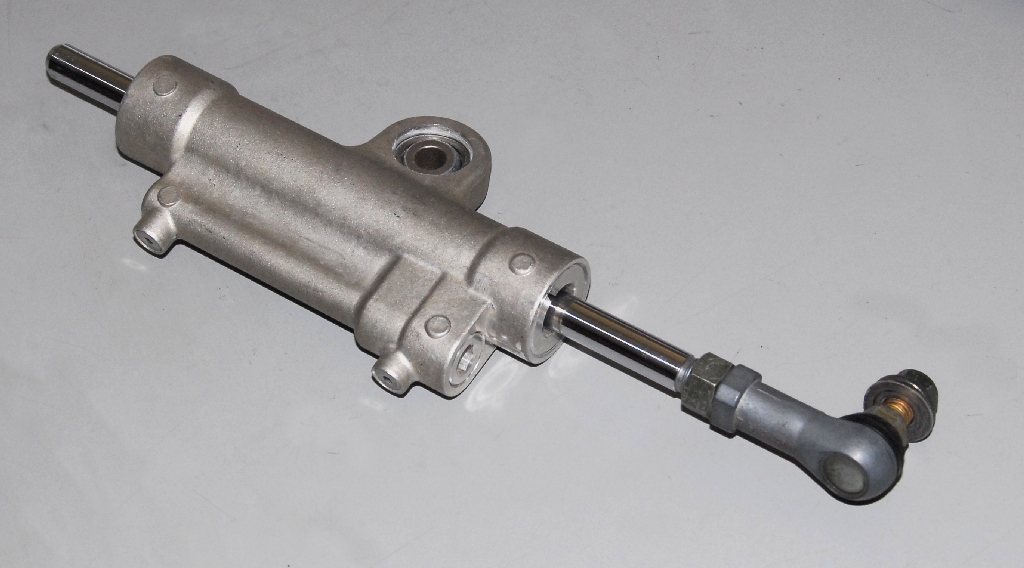
hydraulic-damper.jpgAs someone who has always enjoyed buying and selling secondhand goods, the advent of eBay is to me the opening of a Pandora’s Box of wonderful stuff.

I spend probably a minimum of 30 minutes each day scanning eBay, normally looking at the technical books but occasionally also checking search results on cars I own or I would like to own. My wife and I have a feedback record of over 700, accumulated usually through the purchase and sale of small bits and pieces. (And that feedback record is 100 per cent: we’ve met only an extraordinarily small number of people with whom we’ve had any problems at all – and none where the problems couldn’t be resolved.)

But the reason I am mentioning eBay here is because of something I’ve found very useful; something many people may not have thought of. Quite often when modifying cars, I wonder if a standard part fitted to another model will perform the required role. And with their pics and model details, eBay makes a great place to find if those parts exist.

Ride quality…

Posted on October 23rd, 2007 in Driving Emotion,Opinion,Suspension by Julian Edgar

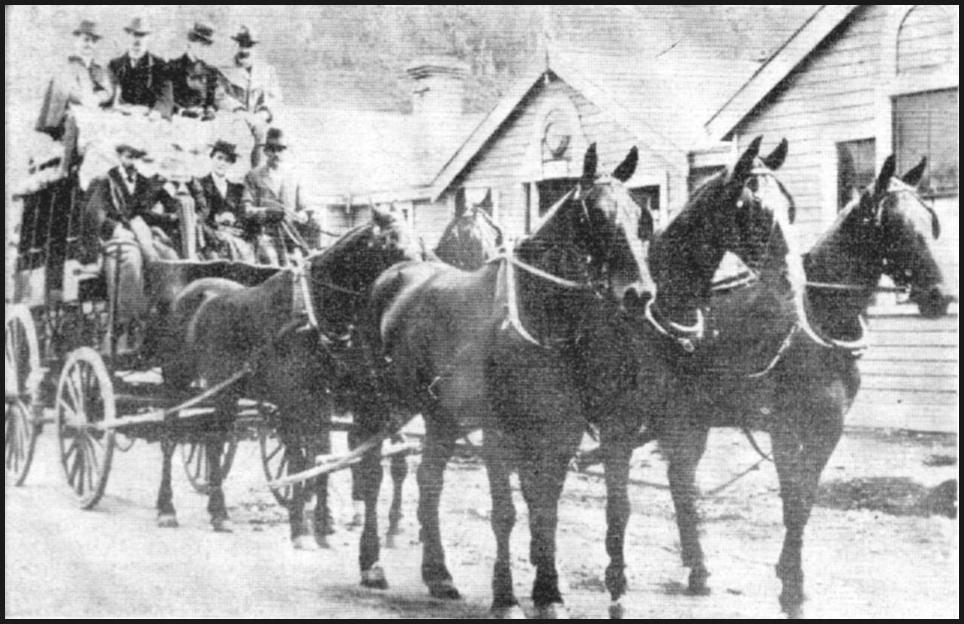
cobb-and-co.jpgI have never been for a ride in a stage coach but it’s something I’d very much like to do. And preferably at full speed, the team of horses at a gallop. Why? Well, primarily because I wonder how well the coaches ride.

I have a book on Cobb & Co, the best known and largest of the stagecoach companies in Australia’s history, and the map showing the routes that the coaches took is stunning. Especially in Queensland, they penetrated way into the inland – true Outback territory. The roads – always dirt and often largely unmade – were terrible and yet the point to point times were actually quite quick. (The coaches ran to timetables like buses do today.)

The coaches used long-travel (and large!) elliptical leaf springs – sometimes transverse as well as longitudinal – and had huge wheels. AFAIK, damping was provided only by the inter-leaf friction of the springs – no dampers were fitted.  In short, the suspension design was as far away from contemporary small wheel, short travel, highly damped suspensions as possible.

But I have a suspicion that these vehicles might have had a very good ride indeed. The large wheels simply wouldn’t have noticed the bumps that a modern car’s wheel would crash into; the very long suspension travel and low natural frequency (at a guess the static deflection would give a resonant frequency near to 1Hz) is close to ideal for human comfort.

A horse-drawn stage coach riding better than a current car? I wonder…

Off the line…

Posted on October 19th, 2007 in Driving Emotion,Holden,Mitsubishi,Power by Julian Edgar

The week that I am writing this we have two press cars. It’s unusual to have two new cars simultaneously; in fact, it’s something I normally strive to avoid unless I am interstate for a period. Then it’s OK because those cars are usually not able to be obtained in my home state – so better to work harder for a short time in order to sample more.

One of the cars is a Mitsubishi 380 VRX 5-speed manual and the other is an automatic 5-speed Holden Epica 2.5.

Both are front-wheel drive but the 380 has 175kW and 343Nm in a body that weighs 1590kg, and the Epica has 115kW and 237Nm and weighs 1500kg.

Clearly, then, the VRX is going to be the faster of the two cars, not only because of its higher flywheel figures outweigh the slightly greater mass but also because its manual transmission has less losses than the Epica’s auto trans.

But is the VRX faster? Not a test in the world is going to show the Epica as being faster than the VRX (or the equivalent in other comparative cars) and yet as is so often the case, the power, torque and mass figures tell a story that is massively incomplete…

It so happened that my wife and I ended up in driving the two cars at the same time. I was in the Epica, she in the VRX – and in front of us a red traffic light. Both in pole position – and when the light turned green, we went for it.

Trouble is, the Epica was ahead all the way to 80 km/h…

Next red light, Georgina got a better launch – but she still took until 60 km /h to get past the Epica.

Simply, the power and torque of the 380 was so great that the traction control kept shutting down the engine as wheelspin occurred.

The same story could be repeated with lots of different cars – those with auto transmissions and insufficient power to break traction (or, to put it another way, a lower torque curve that extends further up the rev range) can be very quick off the line in real world conditions. On the other hand, manual trans cars with bulk off-the-line torque can be relatively slow.

I remember the disbelief when former colleague Michael Knowling wrote of an STi WRX that a Corolla was quicker away from traffic lights; an absolutely true story symptomatic of the STi being the opposite case to the VRX – no bottom-end torque at all…

No matter what figures might show, for real-world quick getaways, very little beats an auto trans matched to an engine that won’t spin the driving wheels.

Touring plans…

Posted on October 18th, 2007 in Automotive News,Driving Emotion,pedal power by Julian Edgar

Regular readers will know that when it comes to shopping, I am happiest digging through the junk at a tip shop, foraging at garage sales or even – if this can be called ‘shopping’ – picking up stuff that others have dumped by the side of the road. In short, glittering neon’d shops and my version of fun don’t go together. (Except, it needs to be said, when buying cameras or watches…)

So today was very unusual. I spent nearly all day with my wife Georgina and 3-year-old son Alexander shopping for brand new items: assessing and evaluating; picking up things, weight being felt in hand; turning products over and over while assessing quality; even putting some things down on the ground and lying on them. Yes, right there in the shop.

And when the day was finished, we’d spent something like AUD$700.

So what were we buying? Camping gear!

After doing a long drive in a diesel Hyundai i30 fell through, both Georgina and I felt all psyched-up for a tour. The Hyundai trip was going to have been a very long one, but when I was mulling-over its cancellation, I realised that the distance travelled wasn’t of that much importance. In fact, in my view, neither was the fact that it was to be done in a car.

Then, almost of its own volition, the thought popped into my head: why not go touring on our trikes?

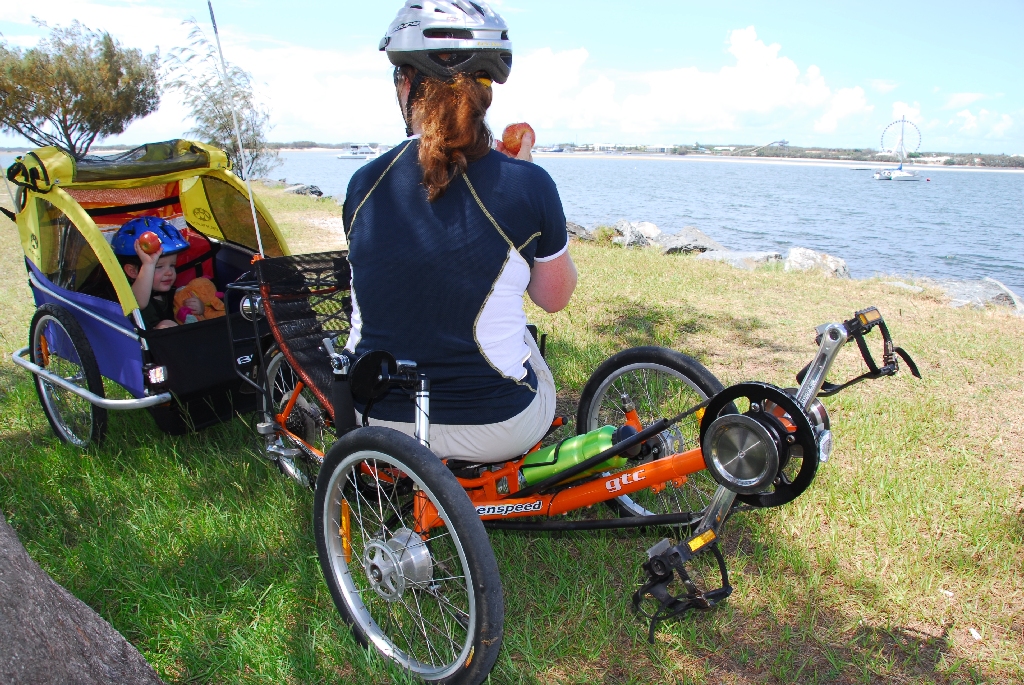
Both Georgina and I are enormous fans of recumbent pedal trikes. These vehicles, which are simply nothing like a bicycle to pedal, incorporate stability and cornering fun in a way impossible to imagine if you’ve not experienced it. (In Georgina’s trike-selling business, over three-quarters of those who book a test ride buy a trike.) 

Talk About Lack of Vision

Posted on October 16th, 2007 in Driving Emotion,Opinion by Julian Edgar

OK, here in Australia it’s the first couple of days into the Federal election campaign and I am already appalled.

Yesterday the Liberal/National coalition Government made, as its first election promise, a pledge that personal tax cuts would be instituted across the board. In fact, no less than AUD$34 billion of tax cuts.

Commentators immediately suggested that in their forthcoming tax policy, the Labour party opposition will probably be forced to match this promise.

Am I the only voter who thinks that this is a AUD$34 billion waste of money? Sure it’s nice for the electorate to have a few more dollars in their pockets but in this time of near record unemployment and low inflation, now is not when we should be reducing the tax take. Instead we should be doing something real and useful with the funds that the country as a whole has available.

Think what that thirty-four billion dollars could do.

It could vastly improve our road network. And ‘vastly’ is a massive understatement.

It could invest hugely in areas in which Australia used to be a leader, areas that our climate lends itself to, technologies that will be in increasing worldwide demand. Solar energy is one obvious candidate: in solar water heating and photo-voltaic cell technologies, Australia was once a leader.

It could invest itself in revolutionising the local car industry to produce cars that would be in world-wide demand.

It could universally introduce zero consumer cost broad-band, in so doing allowing far more to tele-commute to work.

That thirty four billion dollars could be used to address what are surely the most pressing problems facing Australia: potable water supply and energy production. Instead we have state governments struggling on an ad-hoc basis to provide infrastructure that is geared solely to a short-term election cycle. Where are the federal government visionary schemes to transform our system of water harvesting, water recycling and water conservation? Where’s the federal government lead in moving away from coal burning power stations that provide nearly all of Australia’s base-load electricity generating capabilities?

Instead, the election promise is about how many extra dollars you’ll have to buy a huge flat-screen TV…

Note: comments that don’t address the ideas covered here (eg comments that simply say one party is better than the other, or that all politicians are idiots, etc) will be deleted.