An unexpected modification outcome…

Posted on January 25th, 2011 in Aerodynamics,Driving Emotion,testing by Julian Edgar

One of the most exciting aspects about making car modifications is hitting the road and finding out how the car drives after the performance mods have been made. Recently, after fitting new intercooler plumbing, I did just this – but something rather unexpected happened.

But back a few steps.

I’d installed a new intercooler and built its associated pipework but I’d been a bit unhappy with the plumbing: it was about 80 per cent right but I thought I could do better the second time around. I wanted to change aspects like the tightness and number of bends, and to add some brackets to hold the pipes more securely in place. I also decided that this time I wouldn’t grind back any welds, thus leaving the joins much stronger.

So I measured and cut and welded and painted. The end result was one I was much happier with – I reckoned the revised plumbing fitted better, flowed more freely and would be more durable.

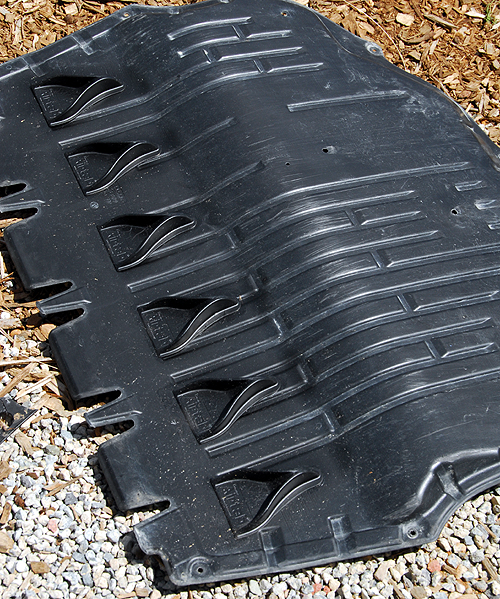
Fitting the plumbing required removing the bumper cover and undertray - a fiddly job. So while the undertray was removed, I decided to add some aero enhancements. Across the full width of the undertray I glued a line of Airtab vortex generators (pictured above). The idea was to encourage the boundary layer to stay attached to the undertray, so better drawing-out air from the engine bay as the flow moved past the end of the tray.

I already had the Airtabs and gluing them in place was only a five minute job – so if they worked, great; and if they didn’t, not much time or money lost.

But when I drove down the road for the first time the Airtabs were furthest from my mind. Because what I could feel was a vibration – a vibration through the floor, gear lever and steering wheel.

Being an older design diesel, the engine in my Skoda Roomster is quite coarse, and so my first thought was that the intercooler plumbing was too firmly mounted, so transferring engine vibration to the bodywork. This idea was a real downer: to access the brackets holding the plumbing would require taking off the undertray and front bumper cover – as I have said, a fiddly exercise. (And I hate doing those sorts of tasks!)

I checked under the bonnet to ensure that the pipework wasn’t banging against anything – but it looked fine. I idled the engine and physically felt the pipes – and yes, there was quite a lot of vibration occurring in them (perhaps also because of internal pressure waves – diesels breathe a lot of air, even at idle). But then again, that’d been the case with the first lot of plumbing – where driving vibration wasn’t an issue.

I went for a longer drive at highway speeds and the vibration was so bad that I knew something had to be done. And it was more than vibration – the car was also noisier. This was terrible – even in standard form the Roomster diesel is no paragon of NVH… and I’d made it a lot worse.

So how much of the noise and vibration was coming from the engine? I drove along at 100 km/h and then selected neutral, letting the revs drop back to idle. And you know what? – most of the vibration and noise remained!

So what the hell was going on?

Then I remembered the vortex generators. Surely, surely they couldn’t be causing these problems? There was only one way to find out – off they came.

Incredibly, the noise and vibration disappeared.

So the vortex generators must have been causing massive turbulence under the car – the vortices perhaps impinging on the floor near the firewall, shaking the car and generating noise. It seems implausible, but there’s no other possible explanation…

Designing a unique vehicle

Posted on February 4th, 2010 in Aerodynamics,automotive history,Materials,Safety,Suspension,testing by Julian Edgar

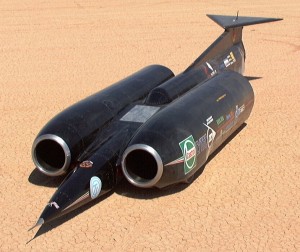
Recently I read Thrust, the book by Richard Noble on his life in breaking land speed records, culminating in the development of the ThrustSSC car – the current world land speed record holder. The record was achieved in 1997.

thrust ssc


The book is outstanding on a number of levels, including its honesty and clarity. The section where driver Any Green describes his techniques for steering the car is just amazing, as is the constant battle for funds that occurred every day of the project.

But one small part of the book particularly interested me: the section where the primary designer Ron Ayers describes how he went about designing the car.

The text is reproduced here:

How do you start designing a vehicle that is totally unique? Here are the characteristics of the problem that faced us:

1. By travelling supersonically on land we would be exploring a region where no-one had ventured, where even the problems could only be guessed at, so there were no known solutions.

2. As the aerodynamic forces involved were so enormous, any accident was likely to be fatal.

3. The project would always be underfunded, short of people and time.

4. There would be only one chance. The final car was also the first prototype. The first lines drawn on paper could well be the ones that are made. The very first assumptions and decisions, if incorrect, could put the project on the wrong track and there would be no chance of starting again.

Problem: how do you make those crucial first decisions when so much is uncertain?

First, every decision had to be a robust one. That meant it couldn’t be invalidated by subsequent decisions.

Second, we could only use technology we were very confident with. This militated against using the very latest technology in some cases.

Third, although direct experience of supersonic travel on land did not exist, we consulted widely, with aviation and automobile experts in industry, universities and research establishments. Experience with Thrust2 was invaluable, particularly in pinpoint¬ing practical and environmental problems that might otherwise be overlooked.

Fourth, where possible we left room for adjust¬ment or change, so we could incorporate knowledge acquired subsequently. Nothing was “hard wired”. One reason for using a steel chassis was that it could be modified if necessary.

Fifth, we didn’t try too hard to integrate the systems. If we needed to change one of them, we didn’t want to be forced to change them all.

Sixth, our choice of a twin-engined car made the design massively overpowered. Thus weight was not a critical factor.

The design resulting from such an approach must necessarily be “sub-optimum”. A second attempt, incorporating the lessons learned, would undoubtedly be better. But the design was proved in practice, and there was little about the basic concept that would need to be changed.

The more you read those notes, the more you realise the clarity of thought being employed: it’s also food for thought for anyone building a unique design of anything.

Noble and Green are currently involved with another land speed record car bid – the Bloodhound SSC.

More on How Much Power You Really Need

Posted on January 29th, 2009 in Aerodynamics,Driving Emotion,Electric vehicles,Opinion by Julian Edgar

Back in this blog I mused about how little power is actually needed in a car. My benchmark was not acceleration or top speed. Instead, it was the ability of a car to climb hills at the open-road speed limit (here in Australia, 110 km/h).

Based on dyno tests and the hill-climbing performance of my diesel Peugeot 405, I decided an at-the-flywheel figure of 35 kW/tonne was about the right minimum.

I applied that idea to electric cars, where for reasons of lightness, battery power consumption and cost, an electric motor that errs on the side of smallness makes sense.

A number of comments were then made that this was completely wrong, that electric motors don’t work in that way (apparently, an electric kilowatt is different to a petrol motor kilowatt!) and so on. However, I saw no evidence that suggested a power/weight ratio of about 35kW a tonne was not the minimum for a car to be competent on the open road. (And a reasonably aerodynamically slippery car, at that.)

Recently, I’ve driven three cars that have a instantaneous power output display on the dashboard. These are all Lexus hybrids – the LS600hL, the GS450h and the RX400h. The latter’s display is shown above.

With this gauge I was able to see exactly how much power was being transmitted to the wheels, irrespective of torque curves, throttle position or anything else.

The actual power going to the wheels.

The RX400h weighs-in at 2040kg – say with my body mass, 2130kg.

Typically, I used in normal driving – even sporty urban driving – an indicated 50kW or less. That’s just a little under 24kW/tonne.

Getting into it more strongly, 75kW showed on the dial – but I stress, this was now going harder than most people would drive most of the time. That’s a power/weight ratio of 35kW/tonne.

To get 100kW (or higher) showing on the gauge, you had to be clearly pushing the car hard.

And 200kW? Full throttle and with lots of revs – completely unlike 99 per cent of daily driving.

I already know from the Peugeot that, if the car is being driven well, 35 kW/tonne is enough for open road driving – and now I know that it’s also sufficient for even quite sporty urban driving.

Cost vs benefit of car modifications

Posted on November 25th, 2008 in Aerodynamics,Driving Emotion,Economy,Honda,Opinion by Julian Edgar

When modifying cars, everyone conducts some sort of cost/benefit analysis.

That might be as informal as weighing-up the likely cost of the modification against the guessed benefit, or it might be a more detailed analysis.

A friend of mine, Paul, has a rule of thumb that goes like this:

Back in 1998, on naturally aspirated cars, he budgeted $100 per kilowatt for a power improvement. Any more than that and he thought the value poor; any better than that and – well, he thought that was pretty good.

That $/kW ratio was for mods like intake, exhaust and chip.

Literally feeling the aerodynamic drag of vehicles

Posted on September 23rd, 2008 in Aerodynamics,Driving Emotion,Economy,Electric vehicles,pedal power by Julian Edgar

As we covered in Analysing Road Car Drag, most aerodynamic drag of current vehicles is created by separation pressure drag. Put simply, this is reflected in the size of the wake – the cross-sectional area of the disturbed air dragged along behind the car.

The most slippery vehicles in the world – the solar race cars – have reduced separation pressure drag to the extent that the other types of drag (eg viscous drag, induced drag and interference drag) become more important.

But in all conventional cars, it’s separation drag that remains the big one.

Now this gives rise to a rather interesting idea. Imagine you’re standing alongside an empty road. The day is a still one – there’s not much wind blowing. A car is rocketing towards you along the road, travelling at perhaps 100 km/h. It will pass close by to you. It grows in size and then roars past.

Now – what do you feel?

Clearly, you will be able to feel the wake – the eddies and turbulent air indicative of the aerodynamic disturbance of the car. This disturbance will take into account the separation pressure drag and the frontal area of the car – the two when multiplied form the vast majority of the actual aero drag that’s experienced by the car.

And, equally clearly, the smaller the air disturbance that you can feel, the greater the slipperiness of the vehicle.

Real Speed

Posted on July 8th, 2008 in Aerodynamics,Driving Emotion,Opinion by Julian Edgar

I recently bought a book published in 1950. Called Speed – the Book of Racing and Records, it covers fast machines on both land and water.

Written at a time when the United Kingdom held most of the records, it’s a brilliant read as the contributors are often the men who held the records. One of the best chapters is by John Cobb, then the holder of the world Land Speed Record.

Here it is.

The idea of building a new kind of car to attack the World’s Land Speed Record, which is the out-and-out fastest that any car of any size has ever travelled on the earth, came when I was driving my big 500h.p. Napier-Railton at Brooklands Track.

This very large car had been constructed for me to designs by my friend Reid Railton, an engineer whose talents, in my opinion, amount to sheer genius. The car was born on a drawing board and although I was perhaps a little dubious about its possible performance, everything that Railton said it would do it did – and rather more. It was admiration for his brains that led me to think that if ever a man could design a car to beat the World’s Record, then held at 300 m.p.h. by Sir Malcolm Campbell’s “Blue Bird”, that man was Reid Railton.

As things turned out, the car he designed for me did exactly as he said; in fact, his theoretical prophecies were rather on the pessimistic side and the car did better than he expected.

Compulsory Aerodynamic Reading

Posted on April 24th, 2008 in Aerodynamics,Driving Emotion,Economy,electric by Julian Edgar

It’s happened only a few times in my life, and each time it’s been a salutary experience.


One occasion I can remember is a long time ago. I was in junior secondary school and was heavily into solar energy. I’d constructed my own solar water heaters, solar pie warmers and other bits of gear. I knew about meridian altitude, I knew about flat plate collectors and thermal mass.


I’d also read all the books I could get my hands on that dealt with solar heating and knew inside-out the (handful) of books on the topic in the school library.


In fact I was pretty smug about my level of knowledge and understanding.


Then a new book came into the library. I can even remember its size and shape – it was a book long in landscape direction and had soft covers. It was also quite thick.


I remember I picked this book and started looking through it with little interest. After all, I already knew everything about solar energy…


But, all of a sudden, I went very quiet and became intent. I was just about to discover a whole new world of solar energy complexity and relevance; my learning on the subject was going to progress hugely.

How much (electric) power is needed?

Posted on January 8th, 2008 in Aerodynamics,Economy,electric,Opinion,Power by Julian Edgar

pug-trip.jpgA while ago I attended an electric car show held in Sydney. I made the 2000-odd kilometre trip in my Peugeot 405 diesel, a car that, incidentally, gained high Fives (in litres/100km) for the trip.

At the show I briefly sampled three of the home-converted electric cars – a very interesting experience. And on the long drive home to the Gold Coast, I had plenty of time to reflect on these cars.

The electric cars I drove each retained the original gearbox: the electric motor was bolted up to the ‘box and the ratios could be selected by the driver. Typically, the cars were started off in second gear and then third and fourth and fifth gears were used as appropriate. (I used first gear off the line and felt an immediate gain in starting performance.)

But none of the cars I drove had performance that came close to conventional petrol engine (or even commercial hybrids). Even when the electric motor was rated at a higher power than the original engine, the massive weight of batteries substantially dulled the resulting power/weight ratio.

Putting in a more powerful electric motor (or running two electric motors) would of course help solve that, but at the expense of greater electrical power consumption that in turn would need either more batteries or result in a shorter range (and none of the ranges were very good to start with!). However, all the cars could easily exceed the 110 km/h open-road speed limit.

Clearly, what is needed is an electric motor that has only enough power to do the job – but no more.

Sourcing Information

Posted on November 22nd, 2007 in Aerodynamics,Opinion,Peugeot,testing by Julian Edgar

Over the years I’ve spent a lot of time in TAFE libraries (for those not living in Australia, technical college libraries). In addition to the very valuable automotive books, it’s the engineering papers that are the most interesting.

Each year the Society of Automotive Engineers publishes numerous technical papers on all topics automotive. You can buy them as downloadable pdfs by going to www.sae.org – but because you can see only a précis of the paper before you need to get out your credit card, this can be an expensive way of acquiring information. However, technical college libraries often have some of the papers, especially in the book form that the SAE occasionally publishes.

The ability to keep on the cutting edge of change is one clear advantage of the SAE engineering papers, but there’s another major advantage that’s often overlooked. And what’s this other advantage? If you own an older car, it’s possible by consulting the papers of that era to find stuff that’s directly relevant to your machine.

walky.jpgIn 1990, when I owned a VL Holden Commodore Turbo, I was frustrated by its lack of aerodynamic development. The standard car was lousy and there were no simple off-the-shelf improvements available. The HDT Brock Commodores had body kits developed with no scientific input, and the pictured groundbreaking ‘Walkinshaw’ Group A, the first HSV model and one shaped with a huge amount of wind tunnel work, was too expensive to buy. (And it didn’t have the turbo engine.) And because the Walky was a near new car, you also couldn’t buy copies of its body kit.

Real racers…

Posted on September 17th, 2007 in Aerodynamics,Driving Emotion,Technologies by Julian Edgar

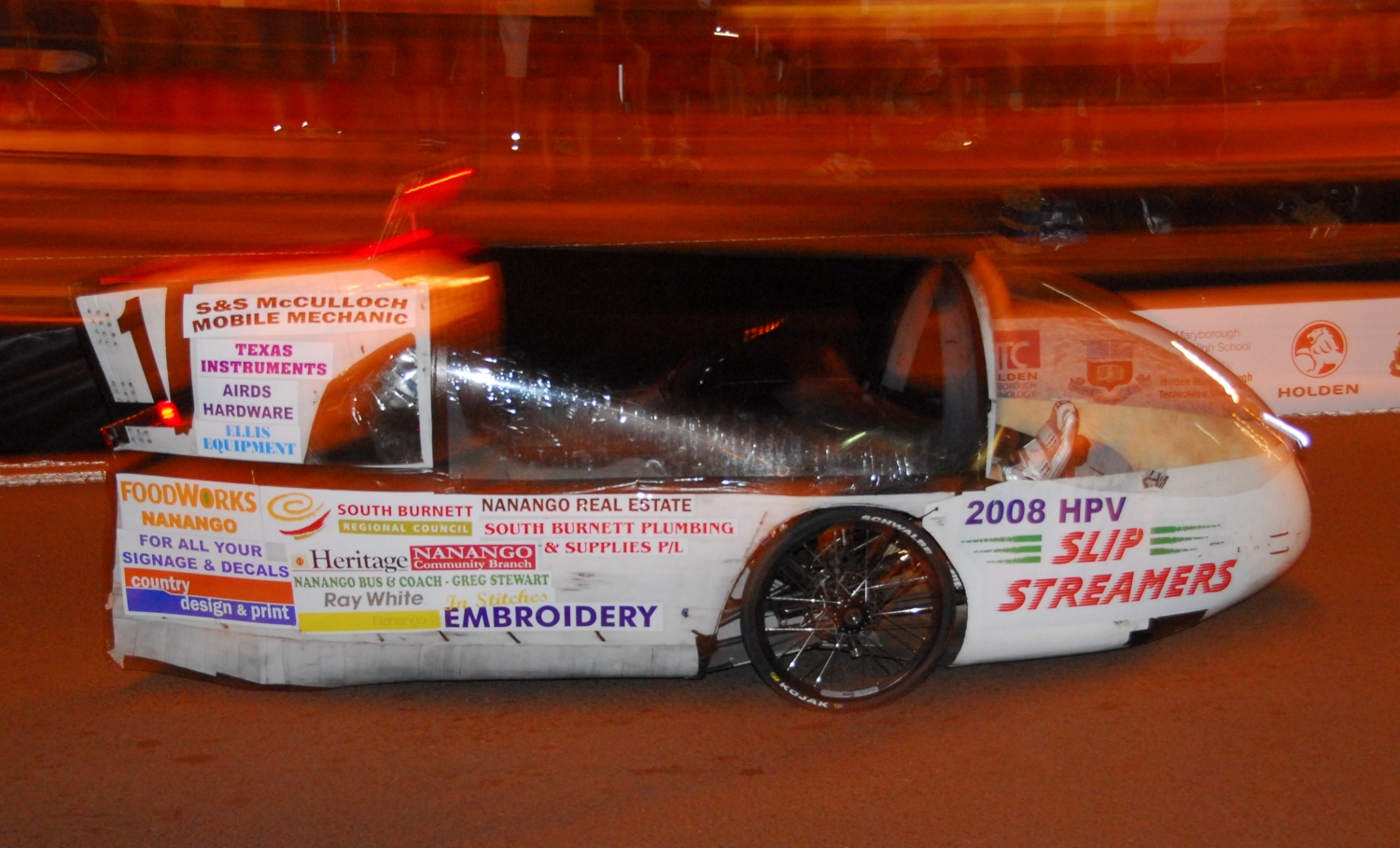
hpv-racer-2.jpgI spent last weekend at Maryborough in Queensland. So what was happening in this pretty town, a little inland from Fraser Island? The Holden-sponsored Maryborough Technology Challenge (MTC), that’s what!  

The MTC consists of technical competitions designed for school students, both primary and secondary. The challenges – that are really races – are fun and pedagogically worthy. Amongst other events, they consist of pushcart races, solar-powered boat races, robotics challenges, CO2-powered miniature drag racing and a human-powered vehicle race.

boats.jpgI went along primarily to watch the human-powered race but found myself much enjoying the solar-powered boats. The boats race side by side in pairs, pushing their way through a long shallow pool. They are kept in line by wire guides following two stretched longitudinal fishing lines.

The differences in boat performance were extraordinary – some boats just plugged along while others lifted their polystyrene noses and powered through the water, leaving a substantial wake. One student that I quizzed told me the electric motor driving his craft was Swiss-made – it was about as big as an AA cell yet gave the boat amazing performance. And of course, all the boats were directly powered by the solar cells mounted on them. As a way of integrating into the curriculum concepts of hydrodynamics, solar cell and motor efficiency, propeller pitch, renewable energy (and of course team-work and co-operation), I thought the boats were fantastic.