
DIY Breakthrough – FuelSmart

Posted on August 18th, 2009 in Economy,testing by Julian Edgar

Improving the fuel economy of vehicles is vastly harder than making them able to go faster: one is simply about jamming-in more fuel (and air) and the other, well, the other is about burning that fuel more efficiently.

That’s why I am so pleased with FuelSmart, the DIY electronic module that we’re covering in AutoSpeed this week and next.

Rather than modify the car’s engine management (or any other system), FuelSmart uses a dashboard LED to show when the car is being driven in a way that is not fuel-efficient. To put it simply: the indication tells you when you’re being a bad driver.

Having now driven many kilometres in my car equipped with FuelSmart, I realise that the action of the LED is training me to adopt a new driving style, one that is demonstrably more economical. It doesn’t mean that I am driving more slowly, it doesn’t mean that I act like there’s an egg between my foot and the throttle, and nor does it mean that the car is being mistreated.

Instead, I use plenty of throttle but get up through the gears fast, I lift right off when approaching traffic lights and other stopping points (rather than leisurely trail-throttle), and in slow-moving traffic I am one gear higher than I previously drove.

The sensitivity of FuelSmart is adjustable: you can set it so that it illuminates the LED only when you’re driving really badly, or at the other extreme, you can set it so that it indicates when you’re driving only a little badly.

During development I tried setting FuelSmart so that it was very sensitive and then went testing in heavy urban traffic. As always, the goal was to keep the warning LED off as much as possible.

And you know what?

After about 30 kilometres of driving, I was exhausted. It was just such hard work keeping the engine absolutely always in its optimal range of throttle position and rpm. The fuel economy was stunning, but hell, was I ever worn out!

Having experienced that extreme, I now run with the FuelSmart adjustment set much more modestly.

With it set in this way, I asked my wife to drive the car to the local shops. “Just drive to keep that new LED switched off as much as possible,” I said.

When she returned, I asked her what she thought.

“Well,” she said, “I’ll take your word for it that it improves fuel economy – it sure doesn’t feel that way! It’s telling me I’m not using enough throttle here, to lift right off there, to change up a gear here – it’s nothing like I expected it to be.”

Yes, I am very pleased with it – FuelSmart is a fascinatingly effective device.

My driving life is now changed forever…

Posted on April 3rd, 2009 in AutoSpeed,Driving Emotion,Economy,electric,Electric vehicles,Global Warming,Opinion by Julian Edgar

I feel like one of the first pilots of jet-powered aircraft. They immediately knew that they were flying the future: there could be no going back to pistons and propellers.

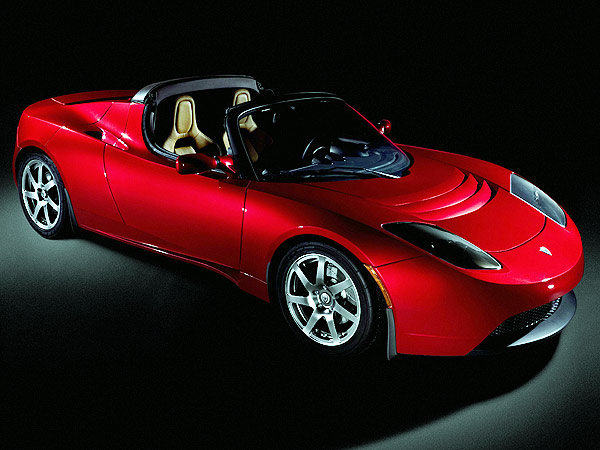
Today I drove the car that, for me, spells the end of the piston engine for performance cars.

The car was the all-electric Tesla, and its performance – and the way it achieved that performance – was just so extraordinary that I am almost lost for words. That a start-up car company has created such a vehicle is simply unprecedented in the last century of automotive development.

For the Tesla is not just a sports car with incredible performance (0-100 km/h in the fours) but also a car that redefines driveability. Simply, it has the best throttle control of any car I have ever driven.

Trickle around a carpark at 1000 (electric) revs and the car drives like it has a maximum of just a few kilowatts available. It’s the pussy cat to end all pussy cats: Grandma could drive it with nary a concern in the world. Put your foot down a little and the car seamlessly accelerates: heavy urban traffic, just perfect.

But select an empty stretch of bitumen and mash your foot to the floor and expletives just stream from your mouth as the car launches forward with an unbelievable, seamless and simply immensely strong thrust.

There are no slipping clutches, no flaring torque converters, no revving engines, no gear-changes – just a swishing vacuum-cleaner-on-steroids noise that sweeps you towards the horizon. The acceleration off the line and up to 100 km/h or so is just mind-boggling – especially as it’s accompanied by such undemonstrative effort. The car will do it again and again and again, all with the same phenomenal ease that makes this the winner of any traffic lights grand prix you’re ever likely to meet.

And it’s not just off the line. Want to quickly swap lanes? Just think about it and it’s accomplished. 

In fact drive the car hard and you start assuming that this is the only mode – outright performance. But then enter that carpark, or keep station with other traffic, and you’re back to driving an utterly tractable car – in fact, one for whom the word ‘tractable’ is irrelevant. Combustion engines are tractable or intractable; this car’s electric motor controller just apportions its electron flow as required, in an endlessly seamless and subtle variation from zero to full power.

It’s not just the acceleration that is revolutionary. The braking – achieved primarily through regen – has the same brilliant throttle mapping, an approach that immediately allows even a newcomer to progressively brake to a near-standstill at exactly the chosen point.

A seamless, elastic and fluid power delivery that no conventional car can come remotely close to matching; a symphony on wheels to be played solely with the right foot; an utterly smooth and progressive performance than can be explosive or docile, urgent or somnambulant – literally, a driveline that completely redefines sports cars.

There’s no going back – my driving life is now changed forever.

Footnote: the Tesla drive was courtesy of Simon Hackett of the ISP, Internode.

The Best DIY Tools and Techniques

Posted on March 31st, 2009 in diesel,Driving Emotion,Economy,Mufflers,Opinion,pedal power,testing by Julian Edgar

This week in AutoSpeed we start a new series that I’ve immodestly called the ‘Ultimate DIY Automotive Modification Kit’.

It’s not the sort of material that you’d find anywhere else but at AutoSpeed - and, perhaps for that reason, longstanding readers will have seen much of the content before.

What the series does is integrate the testing and modification techniques that over the years I’ve discovered  to work for all cars.

Yes, all cars.

Changing the way you think about electric vehicles

Posted on March 17th, 2009 in Automotive News,Driving Emotion,Economy,Electric vehicles,Global Warming,Opinion by Julian Edgar

Today’s AutoSpeed article on electric vehicles is, as the box in the article states, based on a seminar given by Dr Andrew Simpson.

Dr Simpson produced the paper that we used as the foundation for the Assessing the Alternatives article we ran about a year ago – it’s amongst the very best of articles you’ll find in deciding which fuels vehicles should be using.

Andrew Simpson has just returned to Australia from four years in the US, where he worked at the US Government National Renewable Energy Lab in Colorado, and then was a Senior R&D engineer at Tesla Motors.

I found his seminar quite riveting: it changed my views on a host of subjects relating to electric cars.

Colouring your street directory green…

Posted on February 25th, 2009 in books,Economy,Global Warming,Opinion,pedal power by Julian Edgar

The boom in GPS-based navigation systems must have seen a diminution in sales of book-based street directories. I haven’t seen the figures to support that, but it’s certainly what you’d assume to be taking place.

But the companies that produce street directories (and of course in many cases also supply the software for the nav systems) are fighting back.

Optimising turbo boost control for performance and fuel economy

Posted on December 4th, 2008 in Driving Emotion,Economy,Turbocharging by Julian Edgar

The more you think about turbo boost control, the more implications there are for any given system.

Let’s just refer to a traditional wastegate system.

(That’s where there’s a bypass passage – the wastegate – around the turbine. Open the wastegate and exhaust can bypass the turbine, slowing turbo speed and so dropping boost pressure. Remember – the less open the wastegate, the higher the boost pressure.)

In this discussion it doesn’t matter if it’s an electronically controlled system or a simple pneumatic system.

Let’s say that boost pressure is sensed from the compressor outlet of the turbo. If the maximum desired boost is 10 psi, the maximum outlet pressure of the compressor will also be 10 psi.

But the situation changes if the boost pressure is sensed from the intake manifold. If 10 psi is again desired, the boost pressure at the manifold will be 10 psi, but the boost pressure being developed by the turbo will need to be higher.

Cost vs benefit of car modifications

Posted on November 25th, 2008 in Aerodynamics,Driving Emotion,Economy,Honda,Opinion by Julian Edgar

When modifying cars, everyone conducts some sort of cost/benefit analysis.

That might be as informal as weighing-up the likely cost of the modification against the guessed benefit, or it might be a more detailed analysis.

A friend of mine, Paul, has a rule of thumb that goes like this:

Back in 1998, on naturally aspirated cars, he budgeted $100 per kilowatt for a power improvement. Any more than that and he thought the value poor; any better than that and – well, he thought that was pretty good.

That $/kW ratio was for mods like intake, exhaust and chip.

A future for those travelling grey nomads

Posted on September 25th, 2008 in Driving Emotion,Economy,Opinion by Julian Edgar

I am writing this sitting in the Maryborough (Queensland) caravan park’s camp kitchen. My wife, Georgina, and our little boy and I are camping here, having driven up from the Gold Coast, a distance of about 350 kilometres.

I have stayed on and off in caravan parks since about the age of 16; camping in tents or staying in cabins or on-site vans.

Over that time, the biggest change has been in the nature of typical caravan park guests. Once, the people staying in caravan parks comprised almost entirely families with young children. But now, especially in non-holiday periods, caravan parks are dominated by ‘grey nomads’, older, retired people who have hit the road.

Literally feeling the aerodynamic drag of vehicles

Posted on September 23rd, 2008 in Aerodynamics,Driving Emotion,Economy,Electric vehicles,pedal power by Julian Edgar

As we covered in Analysing Road Car Drag, most aerodynamic drag of current vehicles is created by separation pressure drag. Put simply, this is reflected in the size of the wake – the cross-sectional area of the disturbed air dragged along behind the car.

The most slippery vehicles in the world – the solar race cars – have reduced separation pressure drag to the extent that the other types of drag (eg viscous drag, induced drag and interference drag) become more important.

But in all conventional cars, it’s separation drag that remains the big one.

Now this gives rise to a rather interesting idea. Imagine you’re standing alongside an empty road. The day is a still one – there’s not much wind blowing. A car is rocketing towards you along the road, travelling at perhaps 100 km/h. It will pass close by to you. It grows in size and then roars past.

Now – what do you feel?

Clearly, you will be able to feel the wake – the eddies and turbulent air indicative of the aerodynamic disturbance of the car. This disturbance will take into account the separation pressure drag and the frontal area of the car – the two when multiplied form the vast majority of the actual aero drag that’s experienced by the car.

And, equally clearly, the smaller the air disturbance that you can feel, the greater the slipperiness of the vehicle.

Why on earth do people object to making cars easier to drive?

Posted on September 18th, 2008 in Driving Emotion,Economy,Handling by Julian Edgar

I’ll let you into a secret.

I think it quite bizarre, but some people actually believe that the greater the driver skill needed to operate a car, the better the car must be.

The corollary of this is that is if a modification makes it easier to get more out of a car, the modification must be bad.

Now put this way you can see why I called the notion bizarre. But in the time I’ve been writing about car modifications, I’ve come across it quite a few times.

Here are just two examples.