Pledge $10 and (perhaps) create a new suspension system
It’s not every day that you can be part of a new suspension system development.
And wouldn’t you give five or ten bucks to make it happen?
| Magazines: AutoSpeed | V8X | Silicon Chip | Shopping: Property | Cars | Fishing | Musical Instruments | Speed Pedal |
Julian Edgar, 47, has been writing about car modification and automotive
technology for 20 years. He has owned cars with two, three, four, five, six
and eight cylinders; single turbo, twin turbo, supercharged, diesel and
hybrid electric drivelines. He lists his automotive interests as
turbocharging, aerodynamics, suspension design and human powered vehicles.
In the story on suspension design that was published in AutoSpeed today, I said:
One standard model of car that I often see has a clear pitch problem: once you recognise its behaviour, you can see these cars porpoising along on all sorts of road surfaces! (No wonder I felt ill when I rode in the back of one.)
For those of you who live in Australia, that car is the current VE Commodore.
When you are driving in a lane adjacent to a VE Commodore, and especially when you can see it from the rear three-quarters perspective, carefully watch its body behaviour.
What you will see is dramatic pitching over bumps.
Rather than the car as a whole moving up and downwards on its suspension as the bump is met and absorbed, the back rises and falls, and the front rises and falls – and when the back is up, the front is down, and when the back is down, the front is up!
It is fascinating watching a VE pitch, and then watch another car pass over just the same bump and barely pitch at all.
I reckon that Holden suspension ideas have completely forgotten this aspect of suspension design – if of course they even knew of it in the first place.
It’s not every day that you can be part of a new suspension system development.
And wouldn’t you give five or ten bucks to make it happen?
Back here I described my search for the lightest possible springs for a lightweight human-powered vehicle. Although I didn’t say so at the time, it had been my desire to use rubber – light, cheap and readily available.
However, as that article describes, I found it impossible to find a rubber (or elastomer) approach that allowed high spring deflections without overstressing the rubber. High suspension deflections were possible with rubber, but in turn that required high motion ratios (ie leverage) that resulted in large stresses in the suspension arms and spring seats.
However, since writing that article in 2007, I have been reading everything I can find on using rubber as suspension springs – and I have to tell you, there’s not a lot around.
But today I found a paper that I think is worth sharing with you. I can’t share the content – it’s copyright – but I can say it’s the best treatment of using rubber as vehicle springs that I have seen. It was published in 1956 and the author is Alex Moulton, the man who later developed the rubber springing used in the Mini, and the rubber-and-fluid suspension used in the Mini, Austin 1800, Morris 1100 and other vehicles.
You can buy the paper from the Institution of Mechanical Engineers Proceedings Archive here – it will cost you US$30.
If you are interested in lightweight vehicles with sophisticated suspension design, I think it’s a must-read.
The ability of a wheel to move backwards when it hits a bump is a very important ingredient in gaining good ride quality. The movement is accomplished in car suspension systems by the use of rubber bushes; many have asymmetrical voids within them to allow this type of tiny backwards movement without adversely impacting on bush stiffness in other directions.
But what about in a machine that requires suspension pivot points that can’t cater for this movement, ie those that need non-flexible pivots?
In a two wheel machine, especially one that is very light in weight, a leading arm suspension can be designed that will achieve this.
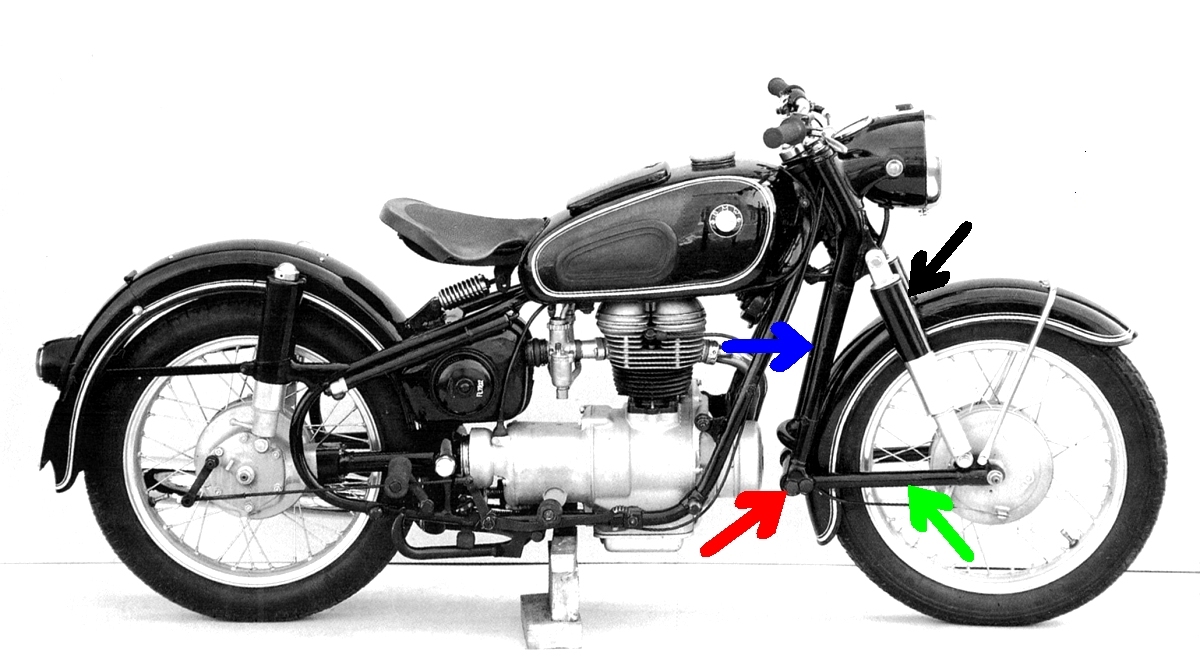
Leading arm suspension systems have been used in commercially produced motorcycles (eg the Earles forks) utilised by BMW in the 1950s, and shown here. Note that the springs/dampers do not locate the suspension in any way, instead, the leading arms (green arrow) are pivoted at the point shown by the red arrow. The “forks” are indicated by the blue arrow and the springs/dampers by the black arrow.
A leading arm design of this type has anti-dive under brakes built in; as the braked wheel tries to keep turning, it pushes up on the pivot point, so counteracting the weight transfer forwards. In fact, some Earles machines are known to rise at the front under brakes.
But how does this front suspension design allow a movement backwards when the wheel hits a bump? As shown in the BMW design, it doesn’t - or at least, not much.
But as shown in the design of this bike, it does. Again the green arrow points to the leading arms, the red arrow to the pivot point, the blue arrow to the spring/damper and the black arrow to the forks. Note how the pivot point is low and so the wheel clearly moves backwards as it rises.
The bike is a Birdy folding machine and the front suspension travel is only about 15-20mm. I recently bought one and I am amazed at how well the front suspension works, especially given its minimal travel. It’s not effective over large bumps but it works brilliantly at removing vibration and harshness.
It’s also a particularly interesting design because in many suspension types, building-in anti-dive geometry actually causes the wheel to move forward as it moves upward, so making bump absorption worse rather than better. That’s not the case with this design.
Recently I read Thrust, the book by Richard Noble on his life in breaking land speed records, culminating in the development of the ThrustSSC car – the current world land speed record holder. The record was achieved in 1997.

The book is outstanding on a number of levels, including its honesty and clarity. The section where driver Any Green describes his techniques for steering the car is just amazing, as is the constant battle for funds that occurred every day of the project.
But one small part of the book particularly interested me: the section where the primary designer Ron Ayers describes how he went about designing the car.
The text is reproduced here:
How do you start designing a vehicle that is totally unique? Here are the characteristics of the problem that faced us:
1. By travelling supersonically on land we would be exploring a region where no-one had ventured, where even the problems could only be guessed at, so there were no known solutions.
2. As the aerodynamic forces involved were so enormous, any accident was likely to be fatal.
3. The project would always be underfunded, short of people and time.
4. There would be only one chance. The final car was also the first prototype. The first lines drawn on paper could well be the ones that are made. The very first assumptions and decisions, if incorrect, could put the project on the wrong track and there would be no chance of starting again.
Problem: how do you make those crucial first decisions when so much is uncertain?
First, every decision had to be a robust one. That meant it couldn’t be invalidated by subsequent decisions.
Second, we could only use technology we were very confident with. This militated against using the very latest technology in some cases.
Third, although direct experience of supersonic travel on land did not exist, we consulted widely, with aviation and automobile experts in industry, universities and research establishments. Experience with Thrust2 was invaluable, particularly in pinpoint¬ing practical and environmental problems that might otherwise be overlooked.
Fourth, where possible we left room for adjust¬ment or change, so we could incorporate knowledge acquired subsequently. Nothing was “hard wired”. One reason for using a steel chassis was that it could be modified if necessary.
Fifth, we didn’t try too hard to integrate the systems. If we needed to change one of them, we didn’t want to be forced to change them all.
Sixth, our choice of a twin-engined car made the design massively overpowered. Thus weight was not a critical factor.
The design resulting from such an approach must necessarily be “sub-optimum”. A second attempt, incorporating the lessons learned, would undoubtedly be better. But the design was proved in practice, and there was little about the basic concept that would need to be changed.
The more you read those notes, the more you realise the clarity of thought being employed: it’s also food for thought for anyone building a unique design of anything.
Noble and Green are currently involved with another land speed record car bid – the Bloodhound SSC.
The trouble with suspension roll centres is that they’re often rather obscure in concept, let alone in location.
In this article I tried to simplify the concept of roll centres, largely by using geometric drawings.
(So what actually is a roll centre? It’s the imaginary point about which the car rolls. The front and rear suspension roll centres can be at different heights above the ground [but always on the centreline of the car] and on different vehicles the heights can vary from being above the ground, to at ground level, to below the ground.)
Normally roll centres are located by careful drawings of the suspension, a prerequisite being that you need to know the exact location of suspension pivot points, lengths of suspension arms and so on.

However, as shown in this diagram, the roll centre of an existing vehicle can be located by directly measuring the way the car behaves. If the car is physically rolled from side to side, there will be one point that never moves (or moves only minimally). That’s the roll centre. If multiple photos are taken of the car in end-view, this point can be easily located.
This is a very useful technique – you can locate the roll centres for either the front or rear suspension, and no difficult measurements of the suspension geometry need be made.
And it’s not just the roll centre(s) that can be located in this way. In addition to roll, cars pitch – that is, the front dives and the rear rises, or vice versa. This occurs not only under acceleration and braking, but also over bumps in the road. The amount of pitch – or, more precisely, the pitch accelerations – are a major determinant of ride quality.
So how do you find the pitch centre? A book I have – Fundamentals of Vehicle Dynamics by Thomas Gillespie – devotes a number of pages of mathematics to locating the pitch centre of a car. However, as with the roll centre, pitch centres can be found by direct measurement.
I did this the other day for my recumbent, pedal, suspension trike. I am doing a lot of work on its suspension, including measuring real-time pitch accelerations over bumpy surfaces. After making a host of measurements of these accelerations, I thought I should find where the pitch centre actually is.
I had two photos taken of the trike (with me on it), both in side view. In one pic, the front suspension was at max extension and the rear in max compression. In the other pic, the suspension extensions were the other way around. (I use air suspension and for this test I interconnected the units front to back, so giving zero resistance to pitch. To get the front to adopt max compression, I added some weights.)
I then overlaid the pics, playing with the image until I could find a point around which the trike body was rotating in pitch. This was best shown by placing radii centred on that point – the circular lines intersect with the same part of the trike in both pitch extremes. (It’s harder to explain than it is to do!)

In this pic, the pink dot is the pitch centre. As can be seen, the greatest mass on the machine (that’s me) is located above the pitch centre. Furthermore, a lot of that mass is located a fair way from the pitch centre, increasing the pitch moment of inertia. This is one reason that over rough ground, the pitch accelerations of the machine are very low.
Talking about moments of inertia in pitch is taking it a further step in complexity. But back to ‘centres’ – if you’re grappling with the suspension design of a custom vehicle, it make things a lot clearer when you can so easily locate not only the roll centres, but also the pitch centre.
One of the automotive ideas that seems to be taken as gospel is that the chassis and suspension arms should be stiff – that is, neither should deflect when subject to load. In fact, if I’d had a dollar for every time I’ve read that ‘good handling depends on a stiff chassis’ I’d be richer than I am.
But I think that, especially for ultra-light vehicles, this notion is simplistic.
Firstly, every structure deflects under load. That deflection may be small, but it occurs. Even the Sydney Harbour Bridge has an allowable deflection under maximum load of 4.5 inches (114mm) in the centre of its span.
Secondly – and more importantly – chasing reduced deflection will add substantially to weight. The corollary of that – the lightest possible vehicle will always have deflections.
Finally, not all deflections are bad.
Let’s start off with the last. Most cars use rubber bushes that are designed to have differing stiffnesses in differing planes. One reason for this is so that wheels can move fractionally backwards when they meet a bump, reducing harshness. Another reason is that in some (many?) suspensions, if the bushes didn’t have ‘give’, the suspension would lock up solid during travel.
Passive steering suspension systems – the first well publicised was the Porsche ‘Weissach’ axle of the 928 – often use bushes that deflect, or links that give an effectively ‘non-stiff’ suspension in some planes.
Going backwards to the second point, getting rid of measurable deflections in chassis and suspension arms will result in a major increase in weight. In ultra-light vehicles (eg those powered by human legs, a small petrol motor or an electric motor), and especially those made from chrome moly steel tube, deflections under major loadings are often able to be seen by eye.
For example, the peripheral torsional wind-up of a front suspension arm might be 5mm or more under maximum braking, and under max cornering there might be 3 or 4mm of bending in wheel supports. In a human powered vehicle (HPV) with a recumbent seat and front pedals, boom flex under maximum pedalling force can often be 10mm or more.
So does all this matter? In some cases (like boom flex, that subtracts from the power available from the rider), yes it does.
But in other cases – not necessarily.
What is required is that the structure is never stressed to the point of failure, and that the vehicle dynamics remain consistent.
I have been musing over these ideas in the context of the HPV I have been building.
I know that under brakes the beam front axle will torsionally wind-up, reducing the static castor of the front, steering wheels. That might lead to steering dartiness under brakes – but for the fact that when the front brakes are in action, the vehicle has some dive, that in turn causes a rapid increase in castor.
On my previous recumbent trike design (called the Air 150), I had difficulties in getting rid of steering twitchiness. The problem felt all the world like toe-in bump steer, where I’d put on some steering lock, the machine would roll slightly – and the outer wheel would toe-in, giving a sharper steering response than requested. That was the theory – but I found this odd when on the workshop floor, toe-in on bump was small or non-existent.
But I now wonder if the outer semi-leading suspension arm wasn’t flexing sideways a little with the sudden application of the lateral force, which in turn caused “turn-in steer” as the suspension arm and the steering tie-rod flexed through different arcs.
Certainly, at the very early stage of testing I am at with my current HPV ‘Chalky’, there’s no steering twitchiness on turn-in – and the front suspension is laterally much stiffer than the previous design.
(I fixed the Air 150′s twitchiness by setting the suspension up with either static toe-out, or toe-out on bump – but the problem returned when carrying really big loads. If the arms were bending laterally, perhaps it just needed even more static or bump toe-out to compensate?)
And I guess that’s the point. In a vehicle – any vehicle – there will be dynamic variations that don’t match the static settings.
(Many years ago, I remember having a wheel alignment done on my Daihatsu Mira Turbo. I was happy with the alignment machine’s read-outs – but then the mechanic got me to sit in the driver’s seat. On that simple car, the suspension settings immediately changed!)
If the weight of the vehicle has been has to be kept to an absolute minimum, and so major deflections occur in the suspension and frame, the trick is to optimise the direction of those deflections so that they don’t subtract from – and possibly even add to – the on-road experience.
That’s a very different notion to ‘keep everything as stiff as possible’.
I am not certain it will happen: I hope so.
As time has passed, the development of ultra light-weight vehicles has become a more important theme for AutoSpeed (and this blog). It’s rather like our longstanding acceptance and enthusiasm for hybrid vehicles: it’s a change in transport architecture that simply makes sense.
(Of course, ultra light-weight vehicles have existed previously – especially just post-World War II with the German and British three wheelers. But over the last 50-odd years, there have been almost none produced.)
So what do I hope will happen? The development of an increasing number of such machines.
If that occurs, especially on an individual constructor level, then people will face some unique and very difficult problems.
We tend to take for granted developed automotive technology, and to see engineering solutions only within that paradigm. But when it comes to ultra light-weight vehicles, that’s simply wrong.
For example, take Ackermann steering – that’s where when cornering, the inner wheel turns at a sharper angle than the outer wheel, resulting in no tyre scrubbing. If I was to say that I have spent the last three days struggling with Ackermann steering, some people would laugh.
“It’s all in the books,” they might say, “just angle to the steering levers inwards like this diagram shows. Been done a million times. Next problem?”
But you see, that solution largely applies only if steering like a car is used – with a steering box or steering rack. And, for ultra lightweight vehicles, both steering boxes and steering racks (or, any currently available, anyway) are way too heavy.
So, how do you achieve Ackermann steering without a steering box or steering rack?
Australian recumbent pedal trike manufacturers Greenspeed have some brilliant solutions. (Disclaimer: my wife sells Greenspeed trikes.)
One of their approaches looks like this (the drawing is not to scale.) The system uses wheels that turn on kingpins, two steering tie-rods, and one central linking member turning on an offset pivot. The steering is by handlebars; these connect at the points marked ‘H’ and have a motion that is a combination of both sideways and fore-aft.
This steering system achieves full Ackermann compensation, and requires only four rod-ends and one pivot point. (These are in addition to the two kingpin pivots.)
That is simply an incredibly light and effective steering system.
I recently spent day after day coming up with alternative steering systems for my recumbent pedal trrike – and then building them. It’s quite easy to end up with steering with two kingpins, six rod-ends and two pivot points – typically, about 50 per cent heavier than the Greenspeed system!
Making things more difficult for me was that, unlike the Greenspeed trikes with the above steering system, my design uses long-travel suspension. And, getting rid of bump steer (ie toe changes with suspension movement) is another nightmare.
Again, people will be thinking only in an automotive paradigm.
“Bump steer? That’s easy – just set the length of the tie-rod so that it’s the same as the distance between lines drawn through the upper and lower ball-joints….” (and so on).
Trouble is, my suspension system doesn’t even have upper and lower ball-joints… Instead, it’s a leading arm, torsion beam, dead axle with a Watts link.
Shown here is (another) rough diagram. In fact, this is pretty well how my system is with Ackerman compensation and zero bump steer. (The really knowledgeable amongst you will have picked a slight error in the drawing.)
The point is that none of this design can take lessons straight out of textbooks – especially automotive textbooks. Of course, the fundamental elements (like the Watts Link, the concept of Akermann steering correction and so on) are all well documented, but in unique applications, actually applying those ideas is another thing entirely.
I am not setting out to suggest I am some kind of hero – all the designers of solar race cars and pedal-powered tadpole trikes have tackled the same ground. But what I am saying is that the challenge is massive, that achieving a good outcome in terms of suspension and steering dynamics – all at a weight that is less than just the steering wheel of a normal car – is difficult beyond belief.
Ackermann and bump steer? If it’s in a typical car textbook, in this class of vehicle it’s usually not the solution…
I thought that the idea that car wheels just went up and down over bumps, and were steered only when the driver turned the steering wheel, was pretty passé.
Passive ‘steer’ systems have been in production cars for many years, normally of the rear end.
In broad brush strokes, the systems work like this: The rear bushes are set with differing stiffnesses in different planes, such that when the wheel is subjected to a lateral force (as it is in cornering), it no longer remains parallel with the car’s long axis – that is, it steers.
For example, rear wheel compliance steer is often set to give toe-in, thus settling the cornering car.
The original Mazda MX5 / Miata had such a system. (It’s worth pointing out that the MX5 is generally regarded as one of the best handling, relatively cheap, cars ever released.) In their 1989 book MX-5 – the rebirth of the sports car in the new Mazda MX5, Jack Yamaguchi and Jonathon Thompson write:
No Mazda rear suspension is complete without some form of self-correcting geometry, as have been seen in the fwd 323 and 626′s TTL (Twin Trapezoidal Links), the 929′s E-links and the RX-7′s complex DTSS. The MX-5 double wishbones are no exception, though to a lesser degree. The designers need not worry about camber changes; a recognized virtue of the unequal length A-arm suspension is the admirable ability to maintain the tires’ contact area true to the road surface, attaining a near-zero camber change.
So the chassis designers’ efforts were directed at obtaining a desired amount of toe-in attitude that improves vehicle stability in such maneuvers as spirited cornering and rapid lane changes. Toe-in was to be introduced when the suspension is subjected to lateral force, not to accelerative or braking force. They considered that the MX-5 with its configuration, weight and suspension, would have sound basic handling characteristics, and the lateral reaction would be all it would require to further enhance its vehicle dynamics.
The lower H arm’s wheel-side pivots, which carry the suspension upright, have rubber bushings of different elasticity rates. The rear pivot is on a firmer rubber bushing than the front. The front rubber bushing deforms more under load induced by lateral force, and introduces an appropriate amount of wheel toe-in, which is in the final production tune a fraction of a degree.
Pretty well all current front-wheel drive cars have some form of passive rear wheel steering. The Honda Jazz uses a tricky torsion beam rear axle in which, according to Honda, “the amount of roll steer and roll camber has been optimised to deliver steady handling”.
But even better, the company has released graphs showing the toe variation over suspension travel (note: travel, rather than lateral force), with the current model compared with the previous design. As can be clearly seen, in bump (as would occur to the outer wheel when cornering) the Jazz (especially the new model) has an increasing amount of toe-in. Also note the differing shape of the curves in rebound (droop).
And it’s not just the ostensibly non-steered end that uses toe variations built into the suspension design.
Several suspension textbooks that I have suggest that setting up the front, steering wheels for non-zero bump steer can be advantageous. Chassis Engineering by Herb Adams (incidentally, a very simple book much under-rated) states:
Exactly how much bump steer you need on your car is like most suspension settings—a compromise. It is common to set the bump steer so that the front wheels toe-out on a bump. This will make the car feel more stable, because the car will not turn any more than the driver asks.
To understand this effect, picture what would happen if your car had toe-in on bump. As the driver would start a turn, he would feed in a certain amount of steering angle. As the car built up g-forces, the chassis would roll and the outside suspension would compress in the bump direction. If the car had toe-in on bump, the front wheels would start to turn more than the driver asked and his turn radius would get tighter. This would require the driver to make a correction and upset the car’s smooth approach into the turn. The outside tire is considered in this analysis because it carries most of the weight in a turn.
Assuming that your car has the bump steer set so that there is toe-out in the bump direction, the next consideration is how much toe-out. If the car has too much toe-out in bump, the steering can become imprecise, because the suspension will tend to negate what the driver is doing with the steering wheel. Also, if there is too much bump steer, the car will dart around going down the straightaway. A reasonable amount of bump steer would be in the range of .010 to .020 per inch of suspension travel.
Fundamentals of Vehicle Dynamics by Thomas D Gillespie positively describes using roll steer, where the toe variation of the left-hand and right-hand wheel is in the same direction, to alter understeer and oversteer effects.
Even that most exotic of road cars, the McLaren F1, had designed-in passive steer.
Writing in an engineering paper released in 1993, SJ Randle wrote of the front suspension: “Lateral force steer…. was 0.15 degrees/g toe out under a load pushing the contact patch in towards the vehicle centreline. This is a mild understeer characteristic – precisely what we wanted.”
In the case of the rear suspension, “the net result being a mild oversteer characteristic (ie toe out under a force towards the car’s centreline) or around 0.2 degrees/g. We had hoped for an understeer of 0.1 degrees/g.”
Such passive steer suspension behaviour would become especially important in vehicles that, in order to achieve other design aims, have dynamic deficiencies. So for example, a very light car that is aerodynamically neutral in lift, and has a low aero drag, is likely to be susceptible to cross-winds. On bump the passive toe-in of the rear wheels, and toe-out of the front wheels, would help correct this yaw.
Note that adopting these techniques doesn’t require the actual mechanical complexity – or weight – of the suspension systems to change.
But of course it’s quite possible to over-do these effects. As indicated in the quotes above, we’re talking very small steer angle changes. You can’t even transfer the ideas from car to car: the current Honda Jazz steers fine; the Honda City (that apparently uses the Jazz rear suspension) has an unmistakeable, unhappy, ‘rear steer’ feel that is disconcerting on quick lane changes.
But it seems to me that if you are building any bespoke vehicle and simply state point-blank that there should be no bump steer at the front, and no lateral compliance leading to toe changes at the back, you’re taking away a pretty important string from your bow.
Back here I covered how, when I first started to design my Air 150 recumbent trike , I spent a lot of time looking for the lightest possible springs.
I tried rubber springs (in torsion, shear and compression), carbon fibre, elastomers and others.
My initial desire was to use torsion bars, preferably made from spring steel. However, I gave up on doing this for a number of reasons – weight, stress level in the steel (best addressed by using multiple leaves, Volkswagen Beetle style), and the difficulty in fastening the ends of the bar without introducing even higher stresses.
And the Firestone air-springs I chose to use in the final design are still my pick for springs in ultra light-weight vehicles.
But the other day I came across a product that might have changed the situation. It’s a type of skateboard that uses two wheels, mounted in line. The two halves of the board can pivot relative to one another around a longitudinal axis, and the two wheels can rotate, castor style.