
Grossly misleading technical articles

Posted on April 30th, 2009 in AutoSpeed, Opinion by Julian Edgar

Long ago, even before I was a Geography teacher, I studied how to teach it. The head of the Geography department at college was a very smart person, and a brilliant teacher.

One day we were talking about teaching analogies and models, and the difficulty in simplification of knowledge without introducing straight-out erroneous ideas.

His example of the latter was: Clouds bumping into each other make thunder.

Much better, he pointed out, to say even to the youngest child: Thunder happens because of lightning.

In fact, clouds are a good example of these ideas. My little boy, who is 4 years old, asks what clouds are made of.

Tiny, tiny water droplets, I say.

So, how does rain happen, he asks?

I say: The tiny droplets run into each other and join together. When they are big enough, they fall to the ground.

While I am saying this, sometimes I think of a much more sophisticated model: water vapour, latent heat of evaporation and condensation, relative humidity, dew-point, hygroscopic nuclei – and other concepts.

A meteorologist would probably think of vapour pressure, a chemist might think at a molecular level, a physicist might consider terminal velocities, a climatologist might consider climate change, a minister of religion might think of God, an agnostic might think of the magnificence of nature.

In the description of clouds and rainfall that I say to my son, I am conscious of the gross simplifications I am making.

But that’s OK: every single thing I know about the world is a gross simplification of reality.

The intellectual models I use to make sense of what occurs around me are just reducible approximations of what really happens.

When I write technical articles in AutoSpeed, I am conscious that all the time I am presenting fundamentally simplistic models. I hope that they’re not of the ‘clouds bumping into each other make thunder’ type: but they may be.

Recently, I wrote an article on suspension roll centres, virtual pivot points and other ways of analysing suspension designs. In doing so, I consulted five different suspension design textbooks, and also considered very carefully the experience I have in developing human-powered vehicle suspensions, and modifying car suspensions.

As always, I was quite conscious during the writing of the article that the model I was presenting of reality was likely to be flawed: as I have already implied, every model we have of reality is, to a greater or lesser degree, flawed. However, I hoped that the information would benefit people’s understandings, especially in practical outcomes.

The day after finishing the article, I looked through a complex SAE paper on suspension roll centres. This paper immediately debunked several suspension ‘myths’, most of which I had implicitly or explicitly promulgated in the article I had written.

However, the paper was working at a level analogous to the ‘vapour pressure and hygroscopic nuclei’ theory of why rain falls: if I based my article on the SAE paper in question, perhaps less than half of one percent of AutoSpeed readers would understand anything I wrote. (If in fact I could understand it myself!)

So I could easily decide not to write anything at all: if it’s not ‘right’ and ‘correct’, surely it shouldn’t be written?

But that would be like saying to my son: I cannot tell you why rain falls; it’s too hard to understand.

I cannot tell you what a roll centre is; it’s too hard to understand.

Or I cannot tell you what a voltage is; it’s too hard to understand.

I cannot tell you what engine detonation is; it’s too hard to understand.

I cannot tell you how a tyre behaves when cornering, it’s too hard to understand.

And so on.

And these things – and all things – really are too hard to understand… if you want as ‘correct’ an understanding as it is currently possible to have.

Are my articles full of errors? So by definition, very likely.

Anyone who suggests that the technical articles they present for general readers are perfectly correct – or do not mislead in the slightest – just do not understand the nature of knowledge – and how all our descriptions of what goes on around us are just relatively simplistic models.

Me? I try to use the simplest model that’s consistent with not being grossly misleading…

My driving life is now changed forever…

Posted on April 3rd, 2009 in AutoSpeed, Driving Emotion, Economy, Electric vehicles, Global Warming, Opinion, electric by Julian Edgar

I feel like one of the first pilots of jet-powered aircraft. They immediately knew that they were flying the future: there could be no going back to pistons and propellers.

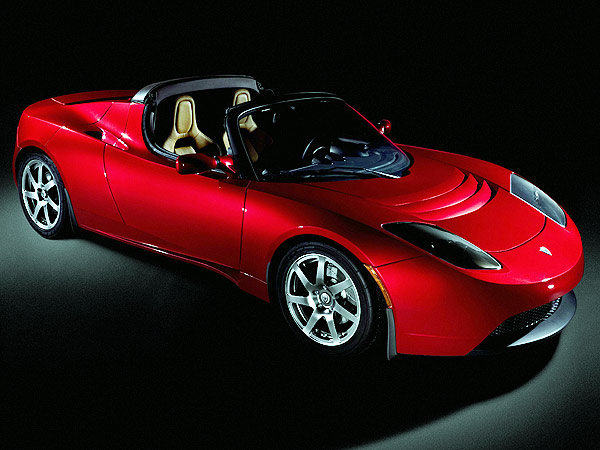
Today I drove the car that, for me, spells the end of the piston engine for performance cars.

The car was the all-electric Tesla, and its performance – and the way it achieved that performance – was just so extraordinary that I am almost lost for words. That a start-up car company has created such a vehicle is simply unprecedented in the last century of automotive development.

For the Tesla is not just a sports car with incredible performance (0-100 km/h in the fours) but also a car that redefines driveability. Simply, it has the best throttle control of any car I have ever driven.

Trickle around a carpark at 1000 (electric) revs and the car drives like it has a maximum of just a few kilowatts available. It’s the pussy cat to end all pussy cats: Grandma could drive it with nary a concern in the world. Put your foot down a little and the car seamlessly accelerates: heavy urban traffic, just perfect.

But select an empty stretch of bitumen and mash your foot to the floor and expletives just stream from your mouth as the car launches forward with an unbelievable, seamless and simply immensely strong thrust.

There are no slipping clutches, no flaring torque converters, no revving engines, no gear-changes – just a swishing vacuum-cleaner-on-steroids noise that sweeps you towards the horizon. The acceleration off the line and up to 100 km/h or so is just mind-boggling – especially as it’s accompanied by such undemonstrative effort. The car will do it again and again and again, all with the same phenomenal ease that makes this the winner of any traffic lights grand prix you’re ever likely to meet.

And it’s not just off the line. Want to quickly swap lanes? Just think about it and it’s accomplished. 

In fact drive the car hard and you start assuming that this is the only mode – outright performance. But then enter that carpark, or keep station with other traffic, and you’re back to driving an utterly tractable car – in fact, one for whom the word ‘tractable’ is irrelevant. Combustion engines are tractable or intractable; this car’s electric motor controller just apportions its electron flow as required, in an endlessly seamless and subtle variation from zero to full power.

It’s not just the acceleration that is revolutionary. The braking – achieved primarily through regen – has the same brilliant throttle mapping, an approach that immediately allows even a newcomer to progressively brake to a near-standstill at exactly the chosen point.

A seamless, elastic and fluid power delivery that no conventional car can come remotely close to matching; a symphony on wheels to be played solely with the right foot; an utterly smooth and progressive performance than can be explosive or docile, urgent or somnambulant – literally, a driveline that completely redefines sports cars.

There’s no going back – my driving life is now changed forever.

Footnote: the Tesla drive was courtesy of Simon Hackett of the ISP, Internode.

The Hidden Story of Reader Ratings

Posted on March 26th, 2009 in AutoSpeed, Driving Emotion, Opinion by Julian Edgar

At the end of all AutoSpeed articles is a reader rating system – you can give any article a score from 1 (bad) to 5 (excellent). As you’d expect, AutoSpeed publisher Web Publications has internal data analysis and display of these reader ratings – now totalling literally hundreds of thousands of scores.

By importing the data into a spreadsheet, I can rank all our articles in terms of numbers of ratings, averaged ratings for individual articles, and so on. I can also see changes over time in the average reader ratings for specific articles.

The other day a reader proposed that, if an article suggests to people ideas they don’t want to hear, they are more likely to give it a low score. So in other words, instead of rating articles on the basis of the quality of journalism, expression, innovative ideas (etc) that are presented, they just rate it on the basis of whether or not they agree with it.

350kW and 0-100 km/h in 4.6 seconds

Posted on March 24th, 2009 in AutoSpeed, Driving Emotion, Intercooling, Power by Julian Edgar

Today I was lucky enough to drive an interesting car.

A 2003 model AMG Mercedes Benz E55, it comes standard with a supercharged 5.4 litre, 3-valves-per-cylinder V8 boosted by a Lysholm compressor spinning at up to 23,000 rpm and pushing air through a water/air intercooler.

Lies, damned lies and statistics!

Posted on March 19th, 2009 in AutoSpeed, Driving Emotion, Opinion by Julian Edgar

From here:

Although sometimes attributed to Mark Twain – because it appears in his posthumously-published Autobiography (1924) – this should more properly be ascribed to Disraeli, as indeed Twain took trouble to do: his exact words being, ‘The remark attributed to Disraeli would often apply with justice and force: “There are three kinds of lies: lies, damned lies, and statistics”.’

And there are no greater ‘damned lies’ than readership or circulation figures for magazines and other publications. To give you an idea, often when a print magazine quotes ‘readership’, they triple or even quadruple their actual sales figures. Why? Because they assume each copy is read by three or four people!

In the same way – or even, come to think of, much worse ways – web sites quote all sorts of figures for their readership.

AutoSpeed’s figures are logged by Google. I can look at our daily figures, weekly figures, annual figures – or even figures for the content, section by section. Further, through internal Web Publications data, I can view readership numbers, article by article. Finally, I can also see the number of reader ratings for each article, and what those ratings are.

Wilful ignorance

Posted on February 23rd, 2009 in AutoSpeed, Driving Emotion, Opinion by Julian Edgar

As I have said in the past, AutoSpeed’s internal data generates a daily referrers’ list, where I can see discussion groups and other web pages from which readers are coming.

I read the referrers’ list (and then follow many links) at least a couple of times a day. It tells me, indirectly, which are our most popular articles for that day, and even more importantly, it also shows me how well each article is understood.

Huh – ‘how well it is understood’?

Well, the sad truth is that many AutoSpeed articles are completely misunderstood by readers. But again, that’s useful to me – if my writing hasn’t been clear enough, or the photos of sufficient quality, then I get to see the outcome expressed loud and clear.

But there’s nothing I can do about wilful ignorance.

Sorry, I have to go fix my Hippo

Posted on February 10th, 2009 in AutoSpeed, Opinion, classics by Julian Edgar

Regular readers will know that I am a voracious consumer of second hand books.

eBay, the Lifeline BookFest (no less than a million second-hand books for sale, and all proceeds benefitting charity!), bookshops (both new and used), garage sales – the sources are endless.

The other day one of the books that lobbed into my post office box was an orphan – a single volume of one of the Newnes Motor Repair sets of the 1950s – and perhaps the early 1960s. The book – Volume 3 of probably a 6 volume set – covers commercial vehicles, tractors and general car repairs (but the latter only the subject titles from ‘B’ to ‘E’).

I was browsing it, looking at the different designs of the (mostly) British vehicles when something suddenly hit me.

The names!

Reader Stories…

Posted on January 27th, 2009 in AutoSpeed, Driving Emotion, Opinion by Julian Edgar

I hate to sound negative but long experience has taught me that if a reader emails that they have a great story for us, the very high likelihood is that it will never happen.

About once every two weeks I get an email.

Hi, I’ve invented a new type of turbo. I am sure you’d like to cover it.

Or,

I’ve developed a breakthrough fuel – you make it yourself. You should do a story on it.

Or, even,

You haven’t done a new car test on my car – it’s a XYZ. Would you like to drive it?

On the off-chance that something will actually eventuate, I always email back a semi-polite reply.

But then the turbo man doesn’t want to send me any real-world test results, or the person who makes their own fuel suddenly goes very quiet, or the person with the new car lives in remote, outback Western Australia.

AutoSpeed in 2009

Posted on January 9th, 2009 in AutoSpeed, Opinion, Reviews, pedal power by Julian Edgar

It’s a new year – so what do we have coming up in AutoSpeed?

In short, it looks to be a great year.

First-up, we’ll be continuing our ‘How to Electronically Modify Your Car’ series. At this stage the series has about 15 parts – it may grow a little. By reading those stories, you can be taken from knowing literally nothing about electronically modifying a car to the stage where you can confidently make changes to analog and digital signals, and understand how car systems can be altered.

In the second half of the year we expect to cover an innovative development in DIY electronics that will put the power of making major, custom electronic modification of cars into the hands of everyone. It’s a development that has been more than 12 months of work in the making, and one that I think is enormously exciting. More on this as we get closer to launch.

Making very bad product planning decisions

Posted on December 16th, 2008 in AutoSpeed, Driving Emotion, Ford, Opinion by Julian Edgar

This is the last blog post for this year, and this week’s edition of AutoSpeed is the last until January 6.

It’s been an interesting year, not least because in response to reader requests, we’ve been again testing more new cars.

I’ve said it before and I’ll say it again – I think that when testing cars, nearly all journalists are way too soft in their criticisms. I mean, to make just a simple point – by definition, half of all new cars should be rated below average and half should be above average.

But read most car tests and you’ll find that nearly all cars are said to be way above average!

I also think that journalists – and especially enthusiasts’ magazines and TV shows – need to in part be blamed for the absurd direction that some manufacturers have taken with their cars.

The car that this year amazed me the most was the Ford FG Falcon.

The model that I would think sells the best – the XR6 – was incredibly off the pace in the things that matter to most purchasers. All I can say is: what on earth was Ford thinking when they set the priorities?

I wrote about this when the car was first released – see The New Falcon – Mostly Irrelevant and the ironic The Ideal Car for the Times - but the car’s reality was even worse than I’d guessed.


Warning: include() [function.include]: URL file-access is disabled in the server configuration in /vol/home/sites/blog.autospeed.com/docs/wp-content/themes/rctic-business-10/footer.php on line 26

Warning: include(http://autospeed.com/cms/redsheriff.dat) [function.include]: failed to open stream: no suitable wrapper could be found in /vol/home/sites/blog.autospeed.com/docs/wp-content/themes/rctic-business-10/footer.php on line 26

Warning: include() [function.include]: Failed opening 'http://autospeed.com/cms/redsheriff.dat' for inclusion (include_path='.:/usr/share/php:/usr/share/pear') in /vol/home/sites/blog.autospeed.com/docs/wp-content/themes/rctic-business-10/footer.php on line 26