My driving life is now changed forever…
Posted on April 3rd, 2009 in AutoSpeed,Driving Emotion,Economy,electric,Electric vehicles,Global Warming,Opinion by Julian Edgar

I feel like one of the first pilots of jet-powered aircraft. They immediately knew that they were flying the future: there could be no going back to pistons and propellers.

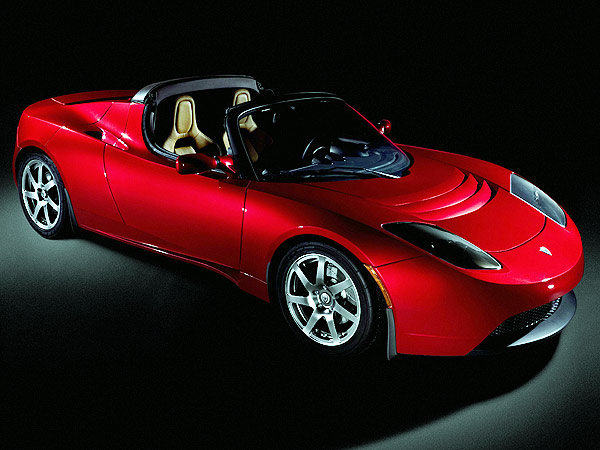
Today I drove the car that, for me, spells the end of the piston engine for performance cars.

The car was the all-electric Tesla, and its performance – and the way it achieved that performance – was just so extraordinary that I am almost lost for words. That a start-up car company has created such a vehicle is simply unprecedented in the last century of automotive development.

For the Tesla is not just a sports car with incredible performance (0-100 km/h in the fours) but also a car that redefines driveability. Simply, it has the best throttle control of any car I have ever driven.

Trickle around a carpark at 1000 (electric) revs and the car drives like it has a maximum of just a few kilowatts available. It’s the pussy cat to end all pussy cats: Grandma could drive it with nary a concern in the world. Put your foot down a little and the car seamlessly accelerates: heavy urban traffic, just perfect.

But select an empty stretch of bitumen and mash your foot to the floor and expletives just stream from your mouth as the car launches forward with an unbelievable, seamless and simply immensely strong thrust.

There are no slipping clutches, no flaring torque converters, no revving engines, no gear-changes – just a swishing vacuum-cleaner-on-steroids noise that sweeps you towards the horizon. The acceleration off the line and up to 100 km/h or so is just mind-boggling – especially as it’s accompanied by such undemonstrative effort. The car will do it again and again and again, all with the same phenomenal ease that makes this the winner of any traffic lights grand prix you’re ever likely to meet.

And it’s not just off the line. Want to quickly swap lanes? Just think about it and it’s accomplished. 

In fact drive the car hard and you start assuming that this is the only mode – outright performance. But then enter that carpark, or keep station with other traffic, and you’re back to driving an utterly tractable car – in fact, one for whom the word ‘tractable’ is irrelevant. Combustion engines are tractable or intractable; this car’s electric motor controller just apportions its electron flow as required, in an endlessly seamless and subtle variation from zero to full power.

It’s not just the acceleration that is revolutionary. The braking – achieved primarily through regen – has the same brilliant throttle mapping, an approach that immediately allows even a newcomer to progressively brake to a near-standstill at exactly the chosen point.

A seamless, elastic and fluid power delivery that no conventional car can come remotely close to matching; a symphony on wheels to be played solely with the right foot; an utterly smooth and progressive performance than can be explosive or docile, urgent or somnambulant – literally, a driveline that completely redefines sports cars.

There’s no going back – my driving life is now changed forever.

Footnote: the Tesla drive was courtesy of Simon Hackett of the ISP, Internode.
Changing the way you think about electric vehicles

Posted on March 17th, 2009 in Automotive News,Driving Emotion,Economy,Electric vehicles,Global Warming,Opinion by Julian Edgar

Today’s AutoSpeed article on electric vehicles is, as the box in the article states, based on a seminar given by Dr Andrew Simpson.

Dr Simpson produced the paper that we used as the foundation for the Assessing the Alternatives article we ran about a year ago – it’s amongst the very best of articles you’ll find in deciding which fuels vehicles should be using.

Andrew Simpson has just returned to Australia from four years in the US, where he worked at the US Government National Renewable Energy Lab in Colorado, and then was a Senior R&D engineer at Tesla Motors.

I found his seminar quite riveting: it changed my views on a host of subjects relating to electric cars.

Colouring your street directory green…

Posted on February 25th, 2009 in books,Economy,Global Warming,Opinion,pedal power by Julian Edgar

The boom in GPS-based navigation systems must have seen a diminution in sales of book-based street directories. I haven’t seen the figures to support that, but it’s certainly what you’d assume to be taking place.

But the companies that produce street directories (and of course in many cases also supply the software for the nav systems) are fighting back.

Time for a Paradigm Shift in Pedal Power

Posted on February 3rd, 2009 in Global Warming,Opinion,pedal power by Julian Edgar

As I write this, I am on holidays – something that also won’t be the case by the time you actually read this!

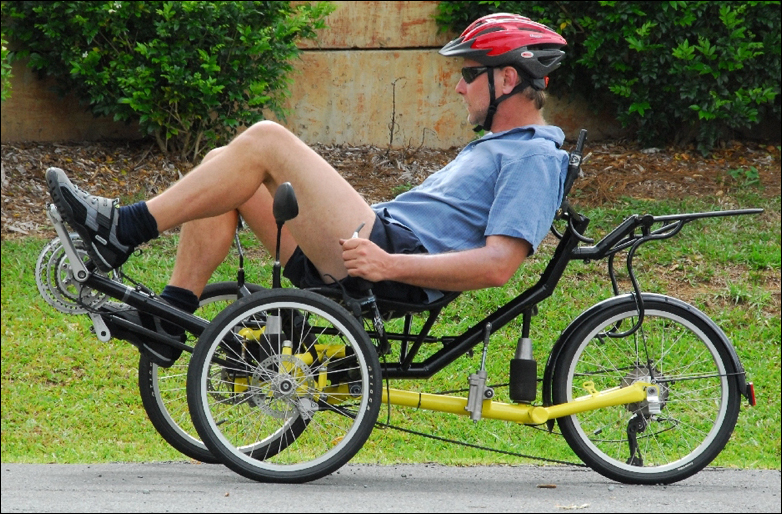
In addition to doing four AutoSpeed stories, I’ve been spending the time cudgelling my brains over my upcoming Human Powered Vehicle project – a front-wheel drive, delta (two rear wheels, one front), recumbent, leaning trike.

I’ve looked through the articles I’ve previously done in AutoSpeed on recumbent pedal trikes (including the tadpole trike pictured above), and have been furiously scanning the web.

Recumbent bikes (where the rider sits back in a reclined seat, the pedals in front of him or her) make up only a tiny minority of bikes worldwide.

Recumbent trikes make up a small minority of that tiny minority – and recumbent, delta, leaning trike designs can be counted on the fingers. Of two hands.

Thus web searches have tended to return to the same sources, taking any one of a number of routes to get there.

As a result of the small number of web pages dealing with this topic, I have had a chance to re-read my posts to an online recumbent bikes/trikes forum, one that has a specific area for homebuilders. Before I was banned, I was almost pleading with those who had developed recumbent trikes to do some testing and measurement of their machines’ performance, so that the tiny community of scattered builders around the world could actually compare designs and see which approaches were best.

Seems an obvious request, but it was met with refusal.

For the Greater Good?

Posted on September 11th, 2008 in Driving Emotion,Economy,Electric vehicles,Global Warming,pedal power by Julian Edgar

Here in Queensland the State Government has issued a discussion paper entitled Improving Sustainable Housing in Queensland.

The paper canvases a range of requirements the government is considering implementing for the construction of new houses and units.

I think it astonishing how little government regulation has been applied to the energy efficiency of housing. Especially in the context of the media attention given to fuel-efficient cars, there seems to have been a deathly silence on what is surely the far more important area of housing.

After all, a typical house is going to be consuming energy for something in the order of five to ten times as long as a car, and will be doing so most hours of the day and night.

Family values and technological change

Posted on September 4th, 2008 in Driving Emotion,Electric vehicles,Global Warming,Hybrid Power by Julian Edgar

I’ve always been a little scornful of those parents who proudly proclaim their children’s knowledge and interests, knowledge and interest that are only a reflection of their parents’ particular knowledge and interests.


You know: “Benjamin can name all the players in the Adelaide Football Club”, proudly says the football fan – and stuff like that.


But now in having a child of my own, I can see that it happens rather naturally – the child is interested in what the parents are interested in, and that knowledge is transferred without effort.


So the fact that my four year old, Alexander, when looking over my shoulder at a book on cars that I am reading, can identify the old Citroens, Jaguar E-Types and Porsches, is perhaps not much of a surprise.


But this familial socialisation becomes interesting when you consider change, and the future.

Without radical action, the end could be near

Posted on August 25th, 2008 in Automotive News,Driving Emotion,Global Warming,Hybrid Power by Julian Edgar

I am starting to wonder if the problems that Ford and Holden are facing in this country with their large cars – the Falcon and the Commodore – are going to be possible to remedy.

Holden is now talking a whole range of environmental and fuel-efficiency measures – from E85 compatibility to reducing weight – and Ford, despite having just released a brand new model, has already made public the next engine option, a diesel.

As I have written previously, both companies have only themselves to blame for their current woes – they were happy completely ignoring the changing marketplace and blindly heading down an ever-increasingly irrelevant path. It’s obvious they expected the market to change to suit them, rather than build cars that suited the buying public. That applies especially to Ford, a company that with the FG Falcon, had years more time to prepare for the changing times than Holden had with the VE Commodore.

But what makes me think that they may have lost it big-time is what I am seeing more and more: Holden and Ford are rapidly losing their loyal long-term potential car-buyers.

Now, self-evidently, they have lost some of these already; otherwise Ford wouldn’t be sacking production workers and releasing a market-special FG seemingly only minutes after the new Falcon was released; and Holden Commodores wouldn’t be being outsold (let’s talk private buyers) by a helluva lot more than just a couple of other car models.

Personal Greenhouse Gas Action Plan

Posted on August 21st, 2008 in Driving Emotion,Economy,electric,Global Warming,Hybrid Power,Opinion by Julian Edgar

Perception of any crisis in world affairs has always followed much the same pattern.

Those who say it isn’t happening and never will happen; those cautious but observant who say it might happen; those early adopters who say it is happening well before a majority agree; and those who like to see it unambiguously demonstrated before acknowledging it is actually happening.

Or – and this is really important – not happening.

Trouble is, at the ‘it might happen’ stage it’s difficult to decide on the right course of action. Do nothing and any action might be too late.

Or, conversely, do nothing and in fact the action might later prove to have been correct.

Think CFCs in aerosols and the ozone layer for the first; think Y2000 bug in computer software for the second.

And the eminence of the ‘early adopters’ counts for little: remember the 1970s predictions of a world overpopulation crisis, and how widespread famine would result in a catastrophic reduction in the population by the year 2000? Despite some very highly credentialed experts arguing vehemently – and with apparent logic – that we were doomed, it didn’t happen.

And now to global warming. 

It’s Time for Trains

Posted on July 31st, 2008 in Global Warming,Opinion by Julian Edgar

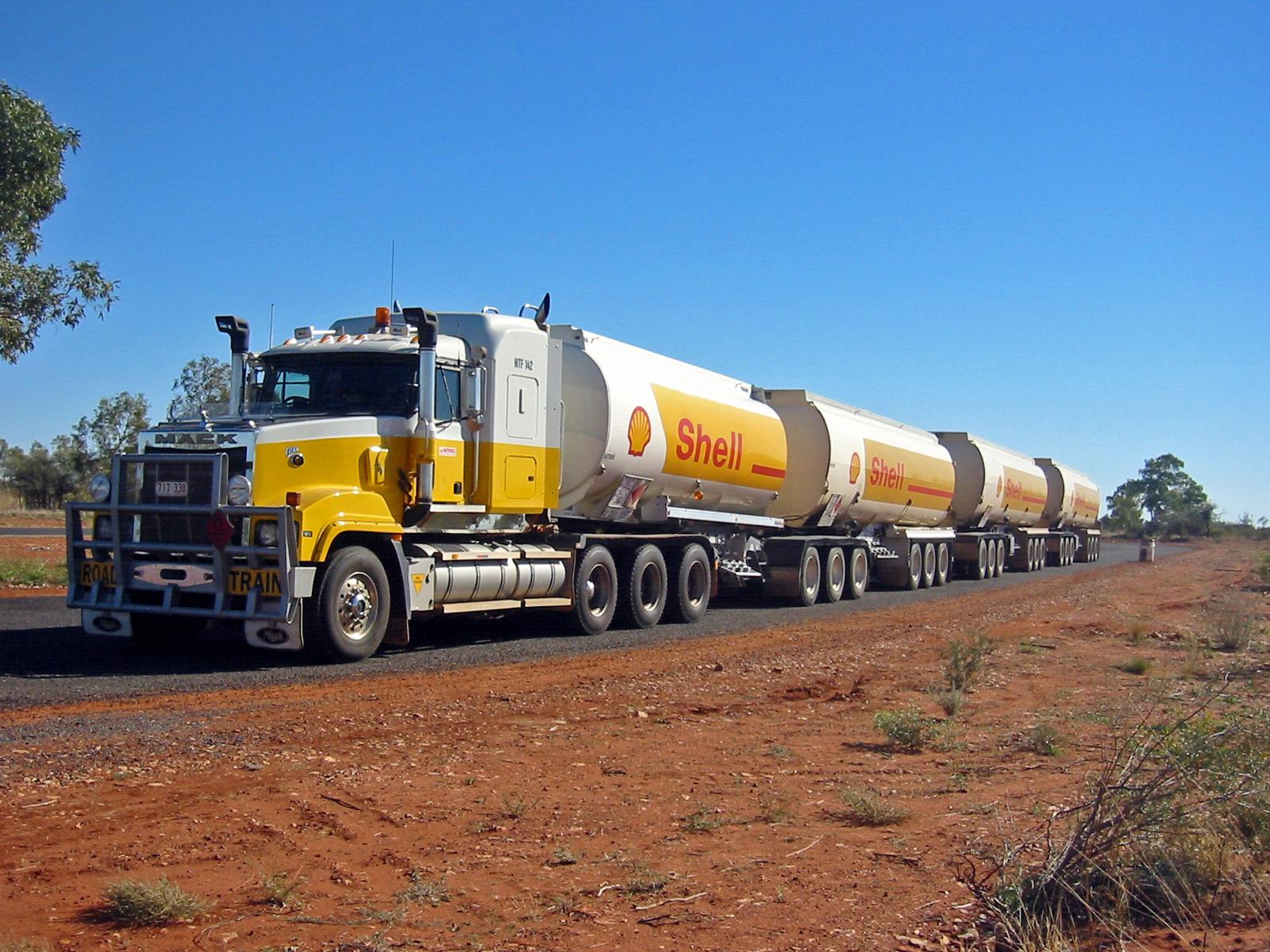
I think one of the most awe-inspiring automotive sights possible is seeing an Outback road-train pulling into a truck stop at night.

Hot, dark air pushed aside by the behemoth, a vehicle that has been driving for hundreds of kilometres into a tunnel of light lit by the huge spotlights, brushing away – depending on the location – ‘roos, rabbits or even bulls.

It’s enough to raise the hairs on your neck, the glorious romance of pushing a load through the immensity of darkness.

Over the years I have listened to many truck drivers talking on the CB, in the distant past on 27 megs and more recently, on UHF. Over that time I have become a fan; being able to talk to these guys, sometimes from a very small car, has given me confidence and understanding and empathy with these drivers of giants.

I love big trucks and enormously admire those who drive them.

But when you start talking interstate hauls, most of their loads should be on trains.

Yep, trains.

It doesn’t matter if you look from the perspectives of road safety, of road maintenance, of greenhouse gas emissions or of total fuel usage.

For long distance, trains do it better.

This article says it better than I can.

I love trucks, but for long distance freight, it’s time for trains.